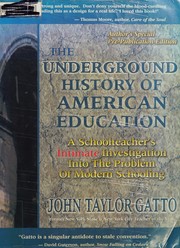
The Underground History of American Education
Attached file
Source files are not served on the public archive. Metadata and citations remain available.
Cited by (256)
- Rockefeller Foundation announces program to control human behavior pp. 1-8
on April 11, 1933, Max Mason, president of the Rockefeller Foundation, announced to insiders that a comprehensive national program was under…
- Howard C. Hill publishes The Life and Work of the Citizen pp. 1-8
In 1935, at the University of Chicago’s experimental school where John Dewey had once held sway, Howard C. Hill, head of the social science…
- Gatto cites high U.S. literacy by 1840 pp. 1-8
Abundant data exist to show that by 1840 the incidence of complex literacy in the United States was between 93 and 100 percent, wherever suc…
- Gatto resigns from teaching pp. 13-14
Finally, on July 5, 1991, I swallowed hard and quit. Twenty days later the Journal published the piece.
- Gatto's estimate of the cost of a schooled child in 2000 pp. 13-14
The cost in New York State for building a well-schooled child in the year 2000 is $200,000 per body when lost interest is calculated.
- Gatto begins teaching in New York City pp. 15-16
When I stepped into the job of schoolteacher in 1961, the new individualism was sitting in the driver’s seat all over urban America
- John Dewey's Pedagogic Creed pp. 15-16
Dewey’s Pedagogic Creed statement of 1897 gives you a clue to the zeitgeist
- Walter Lippmann analyzes the Ludlow Massacre pp. 19-21
The hunt paid off with the discovery of an analysis of the Ludlow Massacre by Walter Lippmann in the New Republic of January 30, 1915.
- Lincoln's brief formal schooling pp. 22-23
Lincoln, hardly a slouch as writer, speaker, or thinker, packed fifty weeks of formal schooling into his entire life over the twelve-year pe…
- English Homily on Obedience set down in 1562 pp. 22-23
the Anglican "Homily On Obedience" set down by English established-church doctrine in the Tudor state of 1562
- Eggleston's The Hoosier Schoolmaster published pp. 22-23
In the humbler setting of rural Indiana recreated by Eggleston for Hoosier Schoolmaster (1871)
- Rules of the Stokes County School pp. 24-26
Rules of the Stokes County School November 10, 1848
- Edward Mandel House at Hopkins Grammar School pp. 24-26
At the Hopkins Grammar School in New Haven at the age of seventeen, during the Hayes-Tilden campaign of 1876, House began to "hang around" p…
- Gatto cites 1995 terrorism death figures pp. 24-26
According to the U.S. State Department, 1995 was a near-record year for terrorist murders; it saw 300 worldwide
- Kenneth Freeman's The Schools of Hellas pp. 27-28
Kenneth Freeman concluded his unique study The Schools of Hellas in 1907 with this summary, "There were no schools in Hellas."
- Gatto dates the shift of colleges toward serving business pp. 27-28
Service to business and the political state became the most important reason for college and university existence after 1910.
- John Jay writes to Jefferson on American enterprise pp. 29-30
John Jay wrote to Jefferson in 1787, "The enterprise of our country is inconceivable"
- Pyramid design placed on the one dollar bill pp. 29-30
the pyramid was kept from public notice until 1935. Then it appeared suddenly on the back of our one dollar bill, signaling a profound shift…
- Boston merchants move to abolish town meetings pp. 31-32
As early as 1784, a concerted effort was made by the Boston business community to overthrow town meetings, replacing them with a professiona…
- Timothy Dwight leads Yale pp. 31-32
Timothy Dwight, longtime president of Yale after 1795, and a pioneer in modern education (advocating science as the center of curriculum), f…
- Andrew Bell publishes account of Hindu monitorial schooling pp. 33-34
In 1797, Bell, now forty-two, published an account of what he had seen and done.
- First Lancaster school opens in New York City pp. 33-34
The first Lancaster school was opened in New York City in 1806; by 1829 the idea had spread to the Mexican state of Texas
- Bell heads National Society to oppose Lancaster pp. 33-34
In 1811, he was named superintendent of an organization to oppose Lancaster’s British and Foreign School Society
- Braddock's defeat at the Monongahela pp. 35-36
On July 9, 1755, two decades and one year before our Revolution commenced under the direction of the same Washington, Braddock executed a br…
- Whiskey Rebellion leaders meet in Monongahela pp. 35-36
In 1791, leaders of the curious "Whiskey Rebellion" met in Monongahela about a block from the place I was born
- Washington marches an army against the Whiskey rebels pp. 35-36
as president assembled 13,000 in 1794 to march into western Pennsylvania to subdue the Whiskey rebels.
- Birth of Benjamin Franklin pp. 37-38
Ben Franklin was born on Milk Street, Boston, on January 17, 1706.
- Franklin sells his business to pursue study pp. 37-38
In 1748, he sold his business in order to devote himself to study, and in a few years, scientific discoveries gave him a reputation with the…
- Franklin sent to England over the Penns pp. 37-38
In 1757, he was sent to England to protest against the influence of the Penns in the government of Pennsylvania, and remained there five yea…
- Massachusetts School Law of 1647 pp. 43-45
the Massachusetts School Law of 1647, legislation attempting to establish a system of schools by government order and providing means to enf…
- Dean Colet founds St. Paul's grammar school pp. 43-45
the reformed Latin Grammar School founded by Dean Colet at St. Paul’s in London in 1510
- Charles Francis Adams compares schools to mills and prisons pp. 43-45
Charles Francis Adams was fooled when he observed in 1880 that what was being cooked up for kids unlucky enough to be snared by the newly pr…
- Calhoun's Social History of the Family pp. 46-47
Arthur Calhoun’s 1919 Social History of the Family notified the nation’s academics what was happening.
- A Sociological Philosophy of Education published pp. 46-47
In 1928, a well- regarded volume called A Sociological Philosophy of Education claimed, "It is the business of teachers to run not merely sc…
- Cubberley's Public Education 1934 edition pp. 46-47
the 1934 edition of Ellwood P. Cubberley’s Public Education in the United States is explicit about what happened and why.
- Zuckerman essay on the American economy in Foreign Affairs pp. 48-49
an article that appeared in the June 1998 issue of Foreign Affairs. Written by Mortimer Zuckerman, owner of U.S. News and World Report
- Rockefeller's General Education Board issues Occasional Letter Number One pp. 50-51
the first mission statement of Rockefeller’s General Education Board as they occur in a document called Occasional Letter Number One (1906)
- U.S. Office of Education funds RAND change-agent studies pp. 50-51
By 1971, the U.S. Office of Education was deeply committed to accessing private lives and thoughts of children. In that year it granted cont…
- NEA president Catherine Barrett on changing child-rearing pp. 50-51
In 1973, Catherine Barrett, president of the National Education Association, said, "Dramatic changes in the way we raise our children are in…
- Bionomics taught at Indiana University pp. 52-53
By 1900, a special discipline existed at Indiana for elite students, Bionomics. Invitees were hand-picked by college president David Starr J…
- Buck v. Bell upholds forced sterilization pp. 52-53
the first formal legislation making forced sterilization a legal act on planet Earth was passed, not in Germany or Japan, but in the America…
- Bernays publishes Crystallizing Public Opinion pp. 52-53
In 1928, Edward L. Bernays, godfather of the new craft of spin control we call "public relations," told the readers of his book Crystallizin…
- Connecticut census records near-universal literacy pp. 56-57
According to the Connecticut census of 1840, only one citizen out of every 579 was illiterate
- Army investigates draftees who faked illiteracy pp. 56-57
Back in 1952 the Army quietly began hiring hundreds of psychologists to find out how 600,000 high school graduates had successfully faked il…
- The Last of the Mohicans published pp. 56-57
Last of the Mohicans, published in 1826, sold so well that a contemporary equivalent would have to move 10 million copies to match it.
- Appleton School Reader for fifth graders pp. 58-59
In 1882, fifth graders read these authors in their Appleton School Reader: William Shakespeare, Henry Thoreau, George Washington, Sir Walter…
- Decline in top SAT scorers between 1972 and 1994 pp. 58-59
In 1972, there were 2,817 American students who reached this pinnacle; only 1,438 did in 1994—when kids took a much easier test.
- Pierre DuPont's claim about American reading pp. 58-59
By 1812, Pierre DuPont was claiming that barely four in a thousand Americans were unable to read well and that the young had skill in argume…
- Cobden compares American and English newspaper reading pp. 60-61
In 1835, Richard Cobden announced there was six times as much newspaper reading in the United States as in England
- Edward A. Ross publishes Social Control pp. 60-61
The religious purpose of modern schooling was announced clearly by the legendary University of Wisconsin sociologist Edward A. Ross in 1901…
- Goddard's Human Efficiency pp. 60-61
H.H. Goddard, said in his book Human Efficiency (1920) that government schooling was about "the perfect organization of the hive."
- Oettinger questions the need for universal literacy pp. 62-63
In 1982, Anthony Oettinger, a member of the private discussion group called the Council on Foreign Relations, asked an audience of communica…
- National Adult Literacy Survey ranks American adults pp. 62-63
It ranks adult Americans into five levels. Here is its 1993 analysis:
- Authorized King James Bible appears pp. 64-65
An official English Bible, the Authorized King James Version, appeared in 1611, preempting all competitors in a bold stroke which changed po…
- Gedike publishes the first look-say primer pp. 64-65
In 1791 he published the world’s first look/say primer, A Children’s Reader Without the ABC’s and Spelling.
- Comenius's Orbis Pictus pp. 64-65
Comenius set down in his famous Orbis Pictus of 1657.
- Boston adopts Gallaudet's whole-word primer pp. 68-69
On August 2, 1836, Gallaudet’s primer was adopted by the Boston Primary School Committee on an experimental basis.
- Horace Mann's European tour and Seventh Report pp. 68-69
Combe helped Mann line up his great European tour of 1843, which was to result in the shattering Seventh Report to the Boston School Committ…
- Cattell claims people read whole words pp. 68-69
received a giant forward push in 1885 from one of the growing core of America’s new "psychologists" who had studied with Wilhelm Wundt at Le…
- Arthur Gates publishes The Improvement of Reading pp. 70-72
In 1927, another professor at Columbia Teachers College, Arthur Gates, laid the foundation for his own personal fortune by writing a book ca…
- Debut of the Dick and Jane pre-primer pp. 70-72
In 1930, the Dick and Jane Pre-Primer taught 68 sign words in 39 pages of story text, with an illustration per page, a total of 565 words
- Founding of the International Reading Association pp. 70-72
In 1956, 56,000 reading professionals formed a look/say defense league called the International Reading Association.
- Caleb Gattegno demonstrates his reading system pp. 75-76
He was brought to the middle school where I worked in 1969 to demonstrate how his new system solved seemingly intractable problems.
- Gatto's teaching license secretly terminated pp. 81-82
On September 3, 1986, my teaching license, which I had held for 26 years, was terminated secretly while I was on medical leave of absence fo…
- Gatto marks 1965 as the turning point in schooling pp. 81-82
Then suddenly in 1965 everything changed.
- Munsterberg becomes Harvard psychology professor pp. 86-87
In 1892, a recent émigré to America from Wilhelm Wundt’s laboratory of physiological psychology at Leipzig, in Saxony, he was a Harvard Prof…
- Manhattan schools perform tonsillectomies without parental consent pp. 86-87
One year later, immigrant public schools in Manhattan began performing tonsillectomies and adenoidectomies in school without notifying paren…
- 'The Proper Study of Mankind' published with foundation funding pp. 86-87
In a famous book, The Proper Study of Mankind (1948), paid for by the Carnegie Corporation of New York and the Russell Sage Foundation
- Horace Mann's Antioch College commencement address pp. 88-89
In a commencement harangue at Antioch College in 1859, he said, "Be ashamed to die until you have won some victory for humanity."
- Unitarian takeover of Harvard pp. 90-91
After the Unitarian takeover of Harvard in 1805, orthodox Calvinism seemingly reached the end of its road
- Campaign to change mathematics teaching launched pp. 90-91
In 1989, according to Loveless, a group of experts in the field of math education launched a campaign
- Massachusetts passes the first state compulsory schooling law pp. 92-93
The list below is a telling record of the long gap between the Massachusetts compulsory law of 1852 and similar legislation adopted by the n…
- Mississippi becomes the last state to adopt compulsory schooling pp. 92-93
Finally in 1918, sixty-six years after the Massachusetts force legislation, the forty-eighth state, Mississippi, enacted a compulsory school…
- Cubberley publishes 'Public Education in the United States' pp. 92-93
Ellwood P. Cubberley’s celebratory history, Public Education in the United States (1919, revised edition 1934)
- William Torrey Harris serves as U.S. Commissioner of Education pp. 94-95
it’s time for you to meet William Torrey Harris, U.S. Commissioner of Education from 1889 to 1906.
- Harris publishes 'The Philosophy of Education' pp. 94-95
Ninety-nine [students] out of a hundred are automata, careful to walk in prescribed paths, careful to follow the prescribed custom.
- NEA reports reverse the Committee of Ten report of 1893 pp. 96-97
Fitzgerald traces the changeover to a pair of influential NEA reports published in 1911 and 1918 which reversed the scholarly determinations
- NEA issues 'Cardinal Principles of Secondary Education' pp. 96-97
That 1918 NEA Report, "Cardinal Principles of Secondary Education," for all its maddening banality, was to prove over time one of the most i…
- Shailer Mathews publishes 'Scientific Management in the Churches' pp. 96-97
wrote his influential Scientific Management in the Churches (1912) to convince American Protestants they should sacrifice independence and a…
- John H. Vincent founds the Chautauqua reading circle pp. 98-99
On August 10, 1878, John H. Vincent announced his plan for the formation of a study group to undertake a four-year program of guided reading…
- William James addresses Harvard's new teachers on Chautauqua pp. 98-99
In 1899, James spoke to an idealistic new brigade of teachers recruited by Harvard
- Rockefeller founds the University of Chicago under Harper pp. 100-102
Dr. Harper left Chautauqua eventually to become Rockefeller’s personal choice to head up a new German-style research university Rockefeller…
- Over a thousand utopian colonies flourish in America pp. 103-104
From 1830 to 1900, over one thousand utopian colonies flourished around the country
- Massachusetts School Committee holds secret schooling discussions pp. 105-106
Beginning about 1840, a group calling itself the Massachusetts School Committee held a series of secret discussions involving many segments…
- Massachusetts passes first modern formal adoption law pp. 105-106
as had the adoption act passed by the nearly identically constituted legislature just four years prior, the first formal adoption legislatio…
- Connecticut court introduces judicial discretion in child custody pp. 105-106
There are clear signs as far back as 1796 that elements in the new American state intended to interpose themselves in corners of the family…
- Mercein v. People asserts state sovereignty over children pp. 107-108
The 1840 case Mercein v. People produced a stunning opinion by Connecticut’s Justice Paige
- 'Best interest of the child' test entered in New York court pp. 107-108
In 1847, Judge Oakley of New York City Superior Court staked a claim that such power "is not unregulated or arbitrary"
- Ontario teacher William Young assaulted amid schooling resistance pp. 109-110
At Brantford, Ontario, in 1863 the teacher William Young was assaulted (according to his replacement)
- Massachusetts reform school gives away children of retrieving parents pp. 109-110
We have felt it to be our duty generally to decline giving them up to their parents and have placed as many of them as we could with farmers…
- John Dewey heralds the end of 'the old individualism' pp. 109-110
In 1932, John Dewey, now elevated to a position as America’s most prominent educational voice, heralded the end of what he called "the old i…
- Three most influential American books published during schooling's rise pp. 111-112
The three most influential books ever published in North America, setting aside the Bible and The New England Primer, were all published in…
- Intellectuals rank Bellamy's 'Looking Backwards' near Das Kapital pp. 111-112
In 1944, three American intellectuals, Charles Beard, John Dewey, and Edward Weeks, interviewed separately, proclaimed Edward Bellamy’s Look…
- Napoleon defeats Prussia at the Battle of Jena pp. 113-115
The seed that became American schooling, twentieth-century style, was planted in 1806 when Napoleon’s amateur soldiers bested the profession…
- Massachusetts enacts the 'Old Deluder Satan' school law pp. 113-115
the "Old Deluder Satan" law of 1642 in Massachusetts and its 1645 extension
- Humphry Davy invents the miner's safety lamp after a fatal explosion pp. 113-115
inventor of the coalmine "safety" lamp after an 1812 explosion in which ninety-two boys and men were killed
- Prussia establishes the first effective secular compulsion schooling pp. 116-117
the human race got its first effective secular compulsion schooling out of Prussia in 1819, the same year Mary Shelley’s Frankenstein, set i…
- William H. Welch travels to Germany for a doctorate pp. 116-117
In 1876, before setting off from America to Germany to study, William H. Welch, an ambitious young Bostonian, told his sister
- Brownson attacks German-style teacher seminaries pp. 116-117
In 1839, thirteen years before the first successful school compulsion law was passed in the United States, a perpetual critic of Boston Whig…
- Albert of Brandenburg declares Prussia a secular kingdom pp. 118-119
In 1525, Albert of Brandenberg declared Prussia a secular kingdom.
- Teutonic Knights secure control of conquered Prussian lands pp. 118-119
By 1281, the Order’s hold on lands once owned by the heathen Slavs was secure.
- John Griscom's 'A Year in Europe' praises Prussian schools pp. 120-121
First was the report of John Griscom, whose book A Year in Europe (1819) highly praised the new Prussian schools.
- Victor Cousin reports to the French government on Prussian schooling pp. 120-121
The most influential report, however, was French philosopher Victor Cousin’s to the French government in 1831.
- Horace Mann's Seventh Report praises Prussian schooling pp. 120-121
The third major testimonial to Prussian schooling came in the form of Horace Mann’s Seventh Report to the Boston School Committee in 1843.
- Compulsory schooling spreads across Europe pp. 122-123
In 1868, Hungary announced compulsion schooling; in 1869, Austria; in 1872, the famous Prussian system was nationalized to all the Germanies…
- Prussia crushes France in the war of 1871 pp. 122-123
When the spirit of Prussian pelotonfeuer crushed France in the lightning war of 1871, the world’s attention focused intently on this hypnoti…
- Banker George Reynolds backs a German-style central bank pp. 124-125
George Reynolds, president of the American Bankers Association, rose before an audience on September 13, 1909, to declare himself flatly in…
- President Taft urges a German-model central bank pp. 124-125
On September 14, 1909, in Boston, the president of the United States, William Howard Taft, instructed the country that it should "take up se…
- University of Chicago textbook decorated with fascist symbols pp. 124-125
At the University of Chicago’s experimental high school, the head of the Social Science department, Howard C. Hill, published an inspiration…
- Colorado coalminer testifies on the eight-hour day pp. 128-129
When a Colorado coalminer testified before authorities in 1871 that eight hours underground was long enough for any man because "he has no t…
- U.S. Bureau of Education circular frames schooling as a business problem pp. 130-131
The first exhibit for your perusal is the U.S. Bureau of Education’s Circular of Information for April 1872, which centers around what it ca…
- Senate committee calls education a cause of labor discontent pp. 130-131
We believe that education is one of the principal causes of discontent of late years manifesting itself among the laboring classes.
- Carnegie publishes 'The Empire of Business' pp. 130-131
In The Empire of Business (1902), Andrew Carnegie, author of the Homestead siege which destroyed the steelworkers union, inveighs against "t…
- Savery patents the 'miner's friend' pump pp. 134-135
A simple pump, "the miner’s friend" patented by Savery in 1699, became Newcomen’s steam pump powered by water boiled over coalfires
- James Watt's steam engine appears in 1776 pp. 134-135
James Watt’s engine, which came along at precisely the moment the Continental Congress was meeting in 1776, was superior in every way
- American railroad trackage explodes as coal replaces wood pp. 134-135
Trackage grew from 1,100 miles in 1836 to 2,800 miles in 1841 to 5,600 miles in 1845, to 11,000 miles in 1850, to 22,000 miles in 1855, to 4…
- United States leads world coal production pp. 136-137
But the United States produced almost as much coal as the other three school-bound nations put together, as you can see from figures for coa…
- Bessemer process transforms steelmaking pp. 136-137
The first part of the new steel revolution followed from discovery of the Bessemer process in 1856.
- Harrison Brown publishes 'The Challenge of Man's Future' pp. 136-137
The full impact of coal-massified societies on human consciousness is caught inadvertently in Cal Tech nuclear scientist Harrison Brown’s Th…
- Steam airplane reportedly flies along the Potomac pp. 138-139
By 1896, heavier-than-air flight had been achieved long before the Wright brothers when a pilotless steam airplane with a forty foot wingspa…
- First important American oil exploitation at Seneca Lake pp. 138-139
The first American exploitation of any importance occurred at Seneca Lake, New York, in 1859, not a long ride from the ancestral home of the…
- Children make up half of American coal miners pp. 138-139
By 1843, when Horace Mann visited coal-dependent Prussia to gather background for his Seventh Report, boys and girls between the ages of fiv…
- Corporations employ most American wage earners pp. 140-141
By 1905, industrial corporations employed 71 percent of all wage earners, mining enterprises 10 percent more.
- Homestead steel strike breaks craft union power pp. 140-141
first, destruction of skilled worker craft unions which, up to the Homestead steel strike in 1892, had regulated the terms of work in a fact…
- Publisher Henry Holt calls for central control of industry pp. 140-141
Henry Holt, the publisher, speaking in 1908, said there was "too much enterprise."
- Japan adopts Prussian constitution and schooling pp. 142-144
In 1868, Japan adopted large parts of the Prussian constitution together with the Prussian style of schooling.
- Boston businessmen meet secretly on universal schooling pp. 142-144
On the night of June 9, 1834, a group of prominent men "chiefly engaged in commerce" gathered privately in a Boston drawing room to discuss…
- Brandeis coins the term 'scientific management' pp. 142-144
The actual term "scientific management" was created by famous lawyer Louis Brandeis in 1910 for the Interstate Commerce Commission rate hear…
- Frederick Taylor testifies before Congress pp. 145-146
Below, he testifies before Congress in 1912
- Bagley's 'Classroom Management' becomes a standard training text pp. 145-146
His jargon-enriched Classroom Management (1907) was reprinted thirty times in the next 20 years
- Atlantic Monthly calls for business organization of schools pp. 145-146
In 1903, The Atlantic Monthly called for adoption of business organization by schools and William C. Bagley identified the ideal teacher as…
- Leonard Ayres publishes 'Laggards in Our Schools' pp. 147-148
In 1909, Leonard Ayres charged in Laggards in Our Schools that although these institutions were filled with "retarded children," school prog…
- J.M. Rice publishes 'Scientific Management in Education' pp. 147-148
famous muckraker J.M. Rice published his own Scientific Management in Education in 1913, showing local "ward" schooling an arena of low-live…
- Kronstadt Commune revolts against Taylorist labor pp. 147-148
The rebellion of the Kronstadt Commune in 1921 charged that Bolsheviks were "planning to introduce the sweat labor system of Taylor."
- George Bernard Shaw states the Fabian use of force pp. 149-150
Fabian George Bernard Shaw established the principle wittily in 1920 when he said that under a Fabian future government
- Darwin's books reshape thinking about children and society pp. 149-150
we need to reflect again on Darwin’s shattering books, The Origin of Species (1859) and The Descent of Man (1871)
- Fabian Society comes into existence pp. 149-150
Fabianism came into existence around the year 1884, taking its name from Roman general Fabius Cunctator
- Beatrice Webb joins the Royal Commission on the Poor Law pp. 151-152
a reasonable date to choose would be the last fortnight of November in 1905 when Beatrice Webb was appointed to the Royal Commission on the…
- Grand dinner honors Herbert Spencer in New York pp. 151-152
Early in 1882 a grand dinner was held in his honor by the great and powerful who gathered to hear scientific proof of Anglo-Saxon fitness fo…
- Brzezinski publishes 'Between Two Ages' pp. 153-154
Zbigniew Brzezinski wrote his famous signature book "Between Two Ages: America’s Role in the Technetronic Era" in 1970
- Thomas Davidson publishes 'History of Education' pp. 153-154
Thomas Davidson’s peculiar and fantastic History of Education.
- Banker Frank Vanderlip praises German schooling to the NEA pp. 155-156
In 1905, the vice president of the National City Bank of New York, Frank Vanderlip, made his way to the speaker’s podium at the National Edu…
- Bobbitt publishes 'Elimination of Waste in Education' pp. 155-156
a more thorough and forceful exposition of its provenance was presented in the Elementary School Teacher by John Franklin Bobbit
- Deweys praise the Gary Plan in 'Schools of Tomorrow' pp. 155-156
soundly praised by first pedagogical couple John and Evelyn Dewey in their 1915 book, Schools of Tomorrow.
- Jewish student riots against the Gary Plan in New York pp. 157-158
Less than three weeks before the mayoral election of 1917, rioting broke out at PS 171, an elementary school on Madison Avenue near 103rd St…
- Public Education Association calls for schools as welfare agencies pp. 157-158
The PEA announced in 1911 an "urgent need" to transform public schools into child welfare agencies.
- First Gary Plan schools open in New York City pp. 157-158
He agreed, and the first Gary schools opened in New York City in March 1915.
- Congress investigates William Wirt's statements pp. 159-160
Its title: Hearings, House Select Committee to Investigate Certain Statements of Dr. William Wirt, 73rd Congress, 2nd Session, April 10 and…
- United States still had 144,102 local school boards in 1930 pp. 159-160
In 1930, when the massive socializing scheme was swinging into high gear, helped substantially by an attention-absorbing depression, this na…
- School administrators grow far faster than students, 1960-1990 pp. 161-162
From 1960 to 1990, while student population was increasing 61 percent, the number of school administrators grew 342 percent.
- Gatto's figure on Black two-parent households in New York, 1960 pp. 161-162
In 1960, when these gigantic child welfare agencies called schools were just setting out on their enhanced mission, 85 percent of African Am…
- Gatto's grandfather ruined in the 1929 crash pp. 163-164
Once she had had much more before Pappy, my granddad, was wiped out in the 1929 crash.
- Monongahela site on the Underground Railroad in the 1850s pp. 165-166
Ninety years earlier it had been a regular stop on the Underground Railroad. The barn of the Anawalt house was used for that purpose all thr…
- Gatto hears the Pearl Harbor announcement on the radio pp. 169-170
I remember FDR on the radio in our postage-stamp living room announcing Pearl Harbor, eight days before my sixth birthday.
- Washington's rules of conduct traced to a 1595 Jesuit manual pp. 171-172
the rules of conduct George Washington carried with him were actually an English translation of a Jesuit manual, Decency Among the Conversat…
- Birth of Frances 'Bootie' Zimmer, Gatto's mother pp. 173-174
Zimmer was born on Halloween in 1911 at Monongahela General Hospital, three years before the country had an income tax or a Federal Reserve…
- Gatto's mother graduates high school in 1929 pp. 173-174
graduated from Monongahela High, where she was a cheerleader, in 1929, a few months before the market crash.
- Pinkertons and the Homestead steel strike pp. 175-176
So the Pinkerton detectives found out when they went to do Andrew Carnegie’s dirty work at Homestead during the steel strike of 1893.
- Smithsonian removes Adena burial mound contents in 1886 pp. 175-176
In 1886, the Smithsonian robbed those graves and took the contents to Washington where they still sit in crates.
- Frances Zimmer marries into the Gatto family in 1932 pp. 175-176
In 1932 Frances Zimmer went off alone on her frightening adventure, marrying into a magnificent Italian family which had pulled itself out o…
- Atlantic Monthly writer warns of immigrant threat to homogeneity pp. 177-178
In 1882, an Atlantic Monthly writer predicted a coming struggle for preservation of the American social order.
- Walter Lippmann indicts modern education, 1940 pp. 177-178
Walter Lippmann, speaking before the Association for the Advancement of Science, December 29, 1940
- Scott Nearing publishes The Super Race in 1912 pp. 179-180
Humanist Scott Nearing wrote his masterpiece, The Super Race: An American Problem, in 1912, just as the drive to destroy an academic curricu…
- Henry Ford distributes The International Jew to schools, 1920 pp. 179-180
in 1920, the Henry Ford Publishing Company distributed 2 million free copies of its recent best seller to all libraries and all schools in t…
- Nazi Germany awards Henry Ford the Grand Cross, 1938 pp. 179-180
On July 30, 1938, the Hitler government presented Henry Ford with the Grand Cross of the Supreme Order of the German Eagle.
- Francis Amasa Walker declares 'racial suicide' in 1891 pp. 181-182
Francis Amasa Walker, president of M.I.T., first declared in 1891 what was soon to become an
- First racial science laboratory opens at Cold Spring Harbor, 1904 pp. 181-182
opened the first racial science laboratory in the world in Cold Spring Harbor, Long Island, in 1904.
- William Z. Ripley publishes The Races of Europe, 1899 pp. 181-182
A scholarly book from M.I.T. created intellectual havoc in the year 1899 and long afterwards, lending maximum credibility to the eugenicist…
- Carrington reports involuntary sterilizations, 1910 pp. 183-184
Charles V. Carrington, writing in the Journal of Criminal Law, Criminology, and Police Science (July 1910), reported on two interesting case…
- Madison Grant publishes The Passing of the Great Race, 1916 pp. 183-184
His magnum opus appeared in 1916 bearing the epic title The Passing of the Great Race, with an introduction by Museum of Natural History lum…
- Carl Brigham asserts Nordic superiority, 1923 pp. 185-186
In his book A Study of American Intelligence, psychologist Carl Brigham concluded in 1923 that
- Frances Kellor publishes Out of Work, 1904 pp. 187-188
Her first muckraking book, Out of Work, was published in 1904.
- 107 cities mark Americanization Day, July 1915 pp. 187-188
When Fourth of July 1915 arrived, 107 cities celebrated it as "Americanization Day,"
- Minnesota passes world's first secret adoption law, 1917 pp. 187-188
At the end of 1917, Minnesota’s legislature approved the world’s first secret adoption law, sealing original birth records forever
- Wave of anti-Bolshevik education laws, 1919 pp. 189-190
By 1919 a deluge of state legislation appeared, specifically designed to counteract rampant Bolshevism.
- Oregon outlaws private elementary schools, 1922 pp. 189-190
In 1922, Oregon outlawed private schools for elementary school children, a decision reversed by the Supreme Court later in the Pierce vs. So…
- Braddock's army defeated on the Monongahela, 1755 pp. 191-192
in the months after Braddock’s army was cut to pieces on October 16, 1755, is a fascinating story
- Church of England men at the 1787 Constitutional Convention pp. 191-192
Russell Kirk estimated twenty-nine of the fifty-five delegates attending the Constitutional Convention of 1787.
- Aztec Club of 1847 founding dinner, 1880 pp. 193-194
Had you been an Aztec at the founding dinner in 1880, you would have been at a table with President Grant and Jefferson Davis, as well as a…
- D.A.R. begins issuing school propaganda lectures, 1898 pp. 195-196
In 1898 the D.A.R., best known of all hereditarian societies, began issuing scientifically designed propaganda lectures on American history…
- David Starr Jordan publishes Your Family Tree, 1929 pp. 195-196
David Starr Jordan, president of Stanford, published his own guide to good blood, Your Family Tree.
- Sir William Jones links Sanskrit and English, 1786 pp. 195-196
Then in 1786, during the early British occupation of India, the subject was addressed anew.
- Horace Bushnell preaches Anglo-Saxon purity, 1837 pp. 197-198
thundered from his pulpit in 1837 that noble Anglo-Saxon blood must be preserved against pollution.
- O'Sullivan equips a war vessel against Cuba, 1851 pp. 197-198
regent O’Sullivan personally equipped a war vessel for an attack on Cuba.
- Henry Maine publishes Ancient Law, 1861 pp. 197-198
His Ancient Law (1861) earned him a world-class reputation in one stroke.
- Fortune reveals where New York policy is really made, 1959 pp. 199-200
In 1959, Fortune magazine shocked a portion of our still innocent nation by announcing where national policy and important deals really were…
- Elite boarding schools founded after Spencer's 1882 visit pp. 199-200
Over 90 percent of the great American private boarding schools issued from that short period just after Herbert Spencer’s American visit in…
- Rockefeller's General Education Board chartered by Congress, 1903 pp. 201-202
Rockefeller’s General Education Board obtained an incorporating act from Congress in 1903 and immediately began to organize schooling in the…
- Congress creates a commission to investigate foundations, 1913 pp. 201-202
In 1913, the Sixty-Second Congress created a commission to investigate the role of these new foundations of Carnegie, Rockefeller, and of ot…
- John Dewey founds the Progressive Education Association, 1919 pp. 201-202
In 1919, using Rockefeller money, John Dewey, by now a professor at Columbia Teachers College, an institution heavily endowed by Rockefeller…
- Reece Commission investigates foundations, 1954 pp. 203-205
In 1954, a second congressional investigation of foundation tampering (with schools and American social life) was attempted, headed by Carro…
- Carnegie's Alan Pifer defends the welfare state, 1982 pp. 203-205
In a report issued in 1982 and widely publicized in important journals, the connection between corporate capitalism and the welfare state be…
- Skinner rears his daughter in a box, 1945 pp. 206-207
a device somewhat mis-described in the famous article "Baby in a Box," (Ladies Home Journal, September 28, 1945).
- B.F. Skinner publishes Walden Two, 1948 pp. 206-207
Walden Two (1948) B.F. Skinner.
- John Watson issues the Behaviorist Manifesto, 1913 pp. 206-207
Watson’s "Behaviorist Manifesto" (1913) promoted a then novel utilitarian psychology
- Watson claims he can train any infant, 1930 pp. 208-209
Was John Watson right when he said in 1930:
- Ivan Pavlov wins the Nobel Prize, 1904 pp. 210-211
Pavlov won the Nobel in 1904, credited with discovering the conditioned reflex
- Rockefeller's Colorado coal-field disaster, 1914 pp. 210-211
After the Rockefeller disaster in the coal fields of southeastern Colorado in April of 1914, ordinary counter-publicity was
- La Mettrie takes refuge with Frederick of Prussia, 1748 pp. 210-211
De La Mettrie was compelled to flee the Netherlands and accept the protection of Frederick of Prussia in 1748.
- E.G. Boring's circular definition of intelligence, 1923 pp. 212-213
The classic statement of behavioristic intelligence is E.G. Boring’s 1923 definition
- Rousseau publishes Emile, 1762 pp. 214-215
The book, Emile, published in 1762.
- John Watson publishes Behaviorism, 1925 pp. 214-215
Dr. John B. Watson, modern father of behaviorism, answered that question this way in the closing paragraphs of his Behaviorism (1925)
- Edna Heidbredder publishes Seven Psychologies, 1933 pp. 214-215
Edna Heidbredder was the first insider to put the bell on this cat in a wonderful little book, Seven Psychologies (1933).
- Atlantic Monthly on the psychologization of schooling, 1993 pp. 216-217
The Atlantic Monthly had this to say in April 1993:
- Bertrand Russell takes a chair at the University of Peking, 1920 pp. 218-219
Bertrand Russell, who assumed a professorship at the University of Peking in 1920, and John Dewey, who lived there for two years during the…
- John Childs writes on experimentalism and China, 1931 pp. 218-219
Listen to an early stage of the plan taken from a Columbia Teachers College text written in 1931.
- Fellenberg's manual-labor schooling fad in the 1830s pp. 218-219
Fellenberg’s doctrine was a short-lived fad in this country in the 1830s, but ever after it had a place in the mind of certain men of affair…
- G. Stanley Hall opens the Johns Hopkins psychology lab, 1887 pp. 220-221
G. Stanley Hall, who organized the psychology lab at Johns Hopkins in 1887, established the American Journal of Psychology
- Cattell founds The Psychological Review, 1894 pp. 220-221
In 1894, he founded The Psychological Review.
- NEA convention questions schooling the masses, 1908 pp. 220-221
this astonishing admission in 1908 at a National Education Association national convention
- Dewey publishes How We Think, 1910 pp. 222-223
By 1910, Dewey was substituting his own five steps for Herbart’s in a book called How We Think.
- G. Stanley Hall coins 'adolescence,' 1904 pp. 222-223
Hall inserted the word "adolescence" into the American vocabulary in 1904.
- White House Conference on Child Health and Protection, 1930 pp. 222-223
In 1930, twelve hundred child development "experts" were invited to the White House Conference on Child Health and Protection, an event with…
- Elementary and Secondary Education Act passed, 1965 pp. 224-225
The watershed moment when modern schooling swept all competition from the field was the passage of the Elementary and Secondary Education Ac…
- Gatto's grant to pay students, 1989 pp. 224-225
In 1989, to my delight, I secured a substantial cash grant from a small foundation to pay kids for what heretofore they
- Everson decision removes God from school, 1947 pp. 226-228
When the second shoe dropped with the Everson decision by the U.S. Supreme Court in 1947, God was pitched out of school on His ear entirely.
- Max Otto publishes Science and the Moral Life, 1949 pp. 226-228
Max Otto argued in his intriguing book-length essay Science and the Moral Life (1949) that a philosophical revolution had been pulled off by…
- Everson v. Board of Education decided pp. 231-232
The Supreme Court decision Everson v. Board of Education 330 U.S. 1. (1947) prepared the dismissal of religion from American public schools.
- Engel v. Vitale and Abington v. Schempp pp. 233-234
A verbal prayer offered in a school is unconstitutional, even if it is both denominationally neutral and voluntarily participated in. Engel…
- Ohio state motto ruled unconstitutional pp. 233-234
In 2000, Ohio’s state motto, "With God, all things are possible," was ruled unconstitutional by the 6th U.S. Circuit Court of Appeals becaus…
- Gatto hears the Dalai Lama at Naropa Institute pp. 233-234
The occasion was a Spirituality in Education conference at the Naropa Institute, Boulder, Colorado, in 1997.
- Factory inspector survey of working children pp. 239-241
In 1909 a factory inspector did an informal survey of 500 working children in 20 factories. She found that 412 of them would rather work in…
- Robert Michels publishes Political Parties pp. 242-243
In 1911, a prominent German sociologist, Robert Michel, warned in his book Political Parties that the size and prosperity of modern bureaucr…
- New York Times reports Harvard rejects valedictorians pp. 242-243
The New York Times of March 9, 2003, reported in an article by Sara Rimer that Harvard rejects four valedictorians out of every five
- Vincent Youmans lectures the London College of Preceptors pp. 246-248
In 1867, world-famous American physician and academic Vincent Youmans lectured the London College of Preceptors about the school institution…
- Wundt founds his psychology laboratory pp. 246-248
The year was 1880, at the very moment Wundt was founding his laboratory of scientific psychology in Germany
- Turkey adopts a new alphabet under Ataturk pp. 251-252
From 1929 on, all books and newspapers were printed in the new alphabet.
- Alexander Inglis publishes Principles of Secondary Education pp. 251-252
Published in 1918 near the end of the great school revolution, Principles offers a unique account of the project written through the eyes of…
- James Bryant Conant serves as president of Harvard pp. 253-254
He was president of Harvard from 1933 to 1953.
- Conant publishes The American High School Today pp. 253-254
His book The American High School Today (1959), was one of the important springs that pushed secondary schools to gigantic size in the 1960s…
- Trilateral Commission report Crisis of Democracy pp. 255-256
A Trilateral Commission Report of 1974, Crisis of Democracy, offered with some urgency this advice: "A program is necessary to lower the job…
- U.S. defense budget in 1939 pp. 259-261
In 1939, on the eve of war, the defense budget of the United States was $11 billion (translated into a constant dollar, year-2000 equivalent…
- Holes appear in Gatto's classroom floor pp. 259-261
In October 1990, three round holes the size of silver dollars appeared in the floor of my classroom at Booker T. Washington Junior High betw…
- 75.5 million people involved in U.S. education by 1999 pp. 262-264
By the end of 1999, 75.5 million people out of a total population of 275 million were involved directly in providing and receiving what has…
- AFT lawyer calls parents 'inconsequential conduits' pp. 265-266
On June 24, 1996, in Franklin County Ohio Common Pleas Court, the attorney for the American Federation of Teachers, speaking against Ohio’s…
- Judge Clark takes over Kansas City schools pp. 267-268
Judge Russell G. Clark took over the Kansas City school district in 1984 after adjudicating a case in which the NAACP acted for plaintiffs i…
- NEA convention offers delegate bounty pp. 267-268
At the 1996 annual convention of the National Education Association, delegates were delighted to learn that the union would pay them a $1000…
- James Koerner publishes Who Controls American Education? pp. 269-270
His book Who Controls American Education? was published in 1968.
- Benson, Vermont rejects its school budget twelve times pp. 269-270
In 1995, just about one hundred years after the inception of modern institutional schooling in America, the little town of Benson in western…
- NEA calls for teaching evolution as fact pp. 271-272
In 1895, the National Education Association announced that school science courses should be reorganized to teach evolution not as theory but…
- Vermont Senate forces a loan on Benson pp. 271-272
In January 1996, the Vermont State Senate passed a bill to forcibly "lend" the Benson School District the full amount of its twelve- time ci…
- Theodore Roosevelt's 1912 Progressive platform pp. 273-274
Teddy Roosevelt’s Progressive platform of 1912 was heavily larded with Croly/Mosca substance, an outlook demanding the public step back and…
- Walter Lippmann publishes Public Opinion pp. 273-274
Lippmann produced his own pair of influential books, Public Opinion (1922), followed by The Phantom Public (1925).
- Karl Polanyi publishes The Great Transformation pp. 275-276
One of the finest academic studies of the origins of our time and its economic antecedents is Karl Polanyi’s The Great Transformation. Publi…
- Gatto's claim of a 1918 Carnegie history meeting pp. 275-276
And in 1918 Carnegie endowed a meeting in London of the American Historical Association where an agreement was made to rewrite American hist…
- Edward Bernays publishes two propaganda books pp. 277-278
In 1928, Bernays published two books in quick succession which planted his flag in the dream terrain of the
- William H. Baldwin's speech at Capon Springs pp. 279-280
By 1899 William H. Baldwin, president of the Long Island Railroad, descendant of the man for whom the Baldwin locomotive was named, demonstr…
- Gatto speaks at Cypress Semiconductor pp. 281-283
I went to Silicon Valley in the middle of 1999 to speak to some computer executives at Cypress Semiconductor on the general topic of school…
- Orestes Brownson publishes 'The Laboring Classes' pp. 284-285
appeared in The Boston Quarterly Review in 1840 at the very moment Horace Mann’s crowd was beating the drum loudest for compulsion schooling…
- Lincoln's 1859 Wisconsin speech on mudsill theory pp. 286-287
Lincoln said in a speech to the Wisconsin Agricultural Society in September 1859 that the goal of government planning should be independent…
- Carl Schurz's first view of America pp. 288-289
Carl Schurz, the German immigrant, said upon seeing America for the first time in 1848
- Carroll Quigley's 1976 Oscar Iden Lectures pp. 288-289
As Quigley approached death, he came back to Georgetown one last time in 1976 to deliver the Oscar Iden Lecture Series.
- Tania Aebi sets out to sail around the world pp. 292-293
Tania Aebi was a seventeen-year-old New York City school dropout bicycle messenger in 1987 when she decided to become the first American wom…
- Prince Charles visits Steel Valley High pp. 294-295
In the bleak winter of 1988 Charles of the blood royal came to visit Steel Valley High in Homestead nominally to talk about turning dead ste…
- G. Stanley Hall invites Freud to the United States pp. 298-299
G. Stanley Hall, the father of school administration, invited Sigmund Freud to the United States in 1909
- Captain John Parker at Lexington pp. 302-304
Captain John Parker, commanding the American militia against the British. Said at first light, Lexington, Massachusetts, April 19, 1775