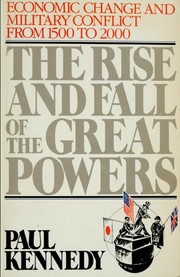
The Rise and Fall of the Great Powers
Attached file
Source files are not served on the public archive. Metadata and citations remain available.
Cited by (381)
- This general balance of political, military, and economic fo whole source
This general balance of political, military, and economic force in Europe was underwritten by an Anglo-French détente lasting nearly two dec…
- Furthermore, the monarchies in London and Paris, not a littl whole source
Furthermore, the monarchies in London and Paris, not a little fearful of their own succession, frowned upon any attempts to upset the status…
- Even a French attack upon the Austrian possessions of Lorrai whole source
Even a French attack upon the Austrian possessions of Lorraine and Milan in 1733, and a French move into the Rhineland, failed to provoke a…
- Britain's annus mirabilis of 1759 whole source
In 1759, the annus mirabilis, French colonies were falling into British hands right across the globe, nicely complementing the considerable…
- Nevertheless, the sheer costs of all this campaigning were s whole source
Nevertheless, the sheer costs of all this campaigning were slowly grinding down Prussian power (60,000 soldiers lost in 1759 alone), and the…
- Spain enters the war and loses its colonies whole source
When Spain foolishly entered the war in 1762, the same fate befell its colonies in the Caribbean and Philippines. Meanwhile, the House of Br…
- The Winning of Wars, 1763–1815
The “breathing space” of wel whole source
The Winning of Wars, 1763–1815 The “breathing space” of well over a decade which occurred before the next stage in the Anglo-French struggl…
- Indeed, Choiseul and his successors, smarting from the defea whole source
Indeed, Choiseul and his successors, smarting from the defeat of 1763, were taking measures to strengthen France’s position for the future.…
- Although Britain’s concessions at the 1783 Peace of Versaill whole source
Although Britain’s concessions at the 1783 Peace of Versailles (Minorca, Florida, Tobago) were hardly a reversal of the great imperial gains…
- In eastern Europe, by contrast, the strategical balances wer whole source
In eastern Europe, by contrast, the strategical balances were not greatly distorted by the maneuvers of the three great monarchies during th…
- War of the Bavarian Succession whole source
The brief and ultracautious campaigning in the War of Bavarian Succession (1778–1779), when Prussia opposed Austria’s attempt at expansion,…
- Nonetheless, the sheer costs of the 1778–1783 war—totaling m whole source
Nonetheless, the sheer costs of the 1778–1783 war—totaling more than France’s three previous wars together—and the failure to reform nationa…
- Third and final partition of Poland whole source
When the third and final partition did occur, in 1795, it was all too evident that Poland had been a more effective ally to France in its de…
- Despite the younger Pitt’s wish to imitate his father in che whole source
Despite the younger Pitt’s wish to imitate his father in checking French expansionism, the British government also failed to pursue the war…
- Napoleon crushes Sardinia-Piedmont, Peace of Campo Formio whole source
This left only Sardinia-Piedmont, which in early 1796 was crushed by Napoleon; the luckless Habsburg Empire, which was driven out of much of…
- This final round of the seven major Anglo-French wars fought whole source
This final round of the seven major Anglo-French wars fought between 1689 and 1815 was to last twelve years, and was the most severely testi…
- This final round of the seven major Anglo-French wars fought whole source
This final round of the seven major Anglo-French wars fought between 1689 and 1815 was to last twelve years, and was the most severely testi…
- Cotton, virtually a new industry before the war, expanded st whole source
Cotton, virtually a new industry before the war, expanded stupendously in the next two decades, absorbing ever more machinery, steam power,…
- Thus, the cotton industry benefited from the Continental Sys whole source
Thus, the cotton industry benefited from the Continental System to the extent that it was protected from superior British competition (not t…
- Even Marseilles, with alternative trading partners in the hi whole source
Even Marseilles, with alternative trading partners in the hinterland and northern Italy, saw its industrial output fall to one-quarter betwe…
- Thus, the cotton industry benefited from the Continental Sys whole source
Thus, the cotton industry benefited from the Continental System to the extent that it was protected from superior British competition (not t…
- Russia withdraws from the Continental System whole source
Few would openly rise in arms, like the Spaniards, or decide to pull out of the ruinous Continental System, as the Russians did in December…
- The British export economy was to receive its severest test whole source
The British export economy was to receive its severest test only in 1812; and until the battle of Leipzig (October 1813) there appeared good…
- Compared with these epic events, the Anglo-American war of 1 whole source
Compared with these epic events, the Anglo-American war of 1812–1814 was a strategical sideshow.94 Economically, it might have been far more…
- For all the talk about a European “Pentarchy,” however, it i whole source
For all the talk about a European “Pentarchy,” however, it is important to recall that the five Great Powers were not in the same relationsh…
- For all the talk about a European “Pentarchy,” however, it i whole source
For all the talk about a European “Pentarchy,” however, it is important to recall that the five Great Powers were not in the same relationsh…
- Controlling most of Europe’s colonies by 1815, dominating th whole source
Controlling most of Europe’s colonies by 1815, dominating the maritime routes and the profitable re-export trades, and well ahead of other s…
- 4Industrialization and the Shifting Global Balances, 1815–18 whole source
4Industrialization and the Shifting Global Balances, 1815–1885 The international system which developed in the half-century and more follow…
- The turbulence and costs of the 1793–1815 struggle—known to whole source
The turbulence and costs of the 1793–1815 struggle—known to the nineteenth century as “the Great War”—caused conservatives and liberals alik…
- Indeed, one of those countries, Britain, benefited so much f whole source
Indeed, one of those countries, Britain, benefited so much from the general economic and geopolitical trends of the post-1815 era that it be…
- In 1870, he notes, the United Kingdom was using 100 million whole source
In 1870, he notes, the United Kingdom was using 100 million tons of coal, which was “equivalent to 800 million million Calories of energy, e…
- In 1870, he notes, the United Kingdom was using 100 million whole source
In 1870, he notes, the United Kingdom was using 100 million tons of coal, which was “equivalent to 800 million million Calories of energy, e…
- “The elemental truth must be stressed that the characteristi whole source
“The elemental truth must be stressed that the characteristic of any country before its industrial revolution and modernization is poverty.……
- In the year 1800, Europeans occupied or controlled 35 percen whole source
In the year 1800, Europeans occupied or controlled 35 percent of the land surface of the world; by 1878 this figure had risen to 67 percent,…
- After 1813 (when the East India Company’s trade monopoly end whole source
After 1813 (when the East India Company’s trade monopoly ended), imports of cotton fabrics into India rose spectacularly, from 1 million yar…
- If the Punjabis and Annamese and Sioux and Bantu were the “l whole source
If the Punjabis and Annamese and Sioux and Bantu were the “losers” (to use Eric Hobsbawm’s term)17 in this early-nineteenth-century expansio…
- First—although it is a somewhat pedantic matter—it is unlike whole source
First—although it is a somewhat pedantic matter—it is unlikely that the country’s gross national product (GNP) was ever the largest in the w…
- On the other hand—and this second point is not a pedantic on whole source
On the other hand—and this second point is not a pedantic one—Britain’s growing industrial muscle was not organized in the post-1815 decades…
- It is therefore hardly an exaggeration to suggest that betwe whole source
It is therefore hardly an exaggeration to suggest that between 1815 and 1880 much of the British Empire existed in a power-political vacuum,…
- Yet whatever the rhetoric of anti-imperialism within Britain whole source
Yet whatever the rhetoric of anti-imperialism within Britain, the fact was that the empire continued to grow, expanding (according to one ca…
- It is therefore hardly an exaggeration to suggest that betwe whole source
It is therefore hardly an exaggeration to suggest that between 1815 and 1880 much of the British Empire existed in a power-political vacuum,…
- The “Middle Powers”
The impact of economic and technologica whole source
The “Middle Powers” The impact of economic and technological change upon the relative position of the Great Powers of continental Europe wa…
- There simply was not enough capital, or local demand, or off whole source
There simply was not enough capital, or local demand, or official enthusiasm, to produce a transformation; and many a European merchant, cra…
- Unlike either the age of Napoleon preceding it or the age of whole source
Unlike either the age of Napoleon preceding it or the age of Bismarck following it, therefore, the period 1815–1865 internationalized most o…
- If the period 1648–1815 had seen the empire “rising” and “as whole source
If the period 1648–1815 had seen the empire “rising” and “asserting itself,”40 that expansion had not eliminated the difficulties under whic…
- If the period 1648–1815 had seen the empire “rising” and “as whole source
If the period 1648–1815 had seen the empire “rising” and “asserting itself,”40 that expansion had not eliminated the difficulties under whic…
- On the contrary, the settlement of 1815 compounded these dif whole source
On the contrary, the settlement of 1815 compounded these difficulties, at least in the longer term. For example, the very fact that the Aust…
- Despite its losses during the Napoleonic War, the position o whole source
Despite its losses during the Napoleonic War, the position of France in the half-century following 1815 was significantly better than that o…
- The overriding fact about the years 1814–1815, at the power- whole source
The overriding fact about the years 1814–1815, at the power-political level, was that all of the other great states had shown themselves det…
- Thus, while Prussia acted as guardian to the Rhineland, Aust whole source
Thus, while Prussia acted as guardian to the Rhineland, Austria strengthened its position in northern Italy, and British influence was expan…
- The Crimean War and the Erosion of Russian Power
Russia’s r whole source
The Crimean War and the Erosion of Russian Power Russia’s relative power was to decline the most during the post-1815 decades of internatio…
- Yet at the economic and technological level, Russia was losi whole source
Yet at the economic and technological level, Russia was losing ground in an alarming way between 1815 and 1880, at least relative to other p…
- On the contrary, the post-1815 preference shown by the Great whole source
On the contrary, the post-1815 preference shown by the Great Powers for ancien régime structures in general could nowhere be more clearly se…
- Military expenditures, which even in peacetime took four-fif whole source
Military expenditures, which even in peacetime took four-fifths of the state revenue, rose from about 220 million rubles in 1853 to about 50…
- Military expenditures, which even in peacetime took four-fif whole source
Military expenditures, which even in peacetime took four-fifths of the state revenue, rose from about 220 million rubles in 1853 to about 50…
- Military expenditures, which even in peacetime took four-fif whole source
Military expenditures, which even in peacetime took four-fifths of the state revenue, rose from about 220 million rubles in 1853 to about 50…
- The first of these was in terms of total population, althoug whole source
The first of these was in terms of total population, although the gap significantly narrowed between 1816 (Russia 51.2 million, United State…
- The first of these was in terms of total population, althoug whole source
The first of these was in terms of total population, although the gap significantly narrowed between 1816 (Russia 51.2 million, United State…
- While its share of world manufacturing output in 1860 was we whole source
While its share of world manufacturing output in 1860 was well behind that of Great Britain, it had already surged past Germany and Russia a…
- As the South’s economy, morale, and front-line forces waned— whole source
As the South’s economy, morale, and front-line forces waned—by the beginning of 1865 its “present for duty” troop total was down to 155,000…
- Its fleet was expanded so that at times (e whole source
Its fleet was expanded so that at times (e.g., 1859) it caused alarm on the other side of the English Channel. Militarily and diplomatically…
- Yet however important the battles of Magenta and Solferino w whole source
Militarily and diplomatically, it seemed to be the decisive third force in any solution of either the German or the Italian question—as was…
- In 1870, the German states combined already possessed a larg whole source
In 1870, the German states combined already possessed a larger population than France, and only disunity had disguised that fact. Germany ha…
- Under Bismarck’s astonishingly adroit handling, the Great Po whole source
Under Bismarck’s astonishingly adroit handling, the Great Power system was going to be dominated by Germany for two whole decades after 1870…
- The Russians, although staying benevolently neutral during t whole source
The Russians, although staying benevolently neutral during the 1870–1871 war and taking advantage of the crisis in western Europe to improve…
- But the great Eastern Crisis of 1876–1878 also did a great d whole source
But the great Eastern Crisis of 1876–1878 also did a great deal for Germany’s relative position. While the small Russian fleet in the Black…
- But the great Eastern Crisis of 1876–1878 also did a great d whole source
But the great Eastern Crisis of 1876–1878 also did a great deal for Germany’s relative position. While the small Russian fleet in the Black…
- While the small Russian fleet in the Black Sea performed bri whole source
While the small Russian fleet in the Black Sea performed brilliantly against the Turks, the Russian army’s 1877 campaigning revealed that it…
- Conclusions
With the important exception of the American Ci whole source
Conclusions With the important exception of the American Civil War, the period 1815–1885 had not witnessed any lengthy, mutually exhausting…
- On the other hand, the relatively stable Pentarchy of the po whole source
On the other hand, the relatively stable Pentarchy of the post-1815 Concert system was dissolving, not merely because its members were more…
- Conclusions
With the important exception of the American Ci whole source
Conclusions With the important exception of the American Civil War, the period 1815–1885 had not witnessed any lengthy, mutually exhausting…
- 5The Coming of a Bipolar World and the Crisis of the “Middle whole source
5The Coming of a Bipolar World and the Crisis of the “Middle Powers”: Part One, 1885–1918 In the winter of 1884–1885, the Great Powers of t…
- While it is obvious that no one in 1885 could accurately for whole source
While it is obvious that no one in 1885 could accurately forecast the ruin and desolation which prevailed in Europe sixty years later, it wa…
- The multipolar world of 1885 was replaced by a bipolar world whole source
The multipolar world of 1885 was replaced by a bipolar world as early as 1943. The international struggle intensified, and broke into wars t…
- Gilchrist and Thomas invent the basic steel process whole source
Within five years of Gilcrist and Thomas’s 1879 invention of a way to turn cheap phosphoric ores into basic steel, there were eighty-four ba…
- Total Population of the Powers, 1890–193817(millions)
There whole source
Total Population of the Powers, 1890–193817(millions) There are, however, two ways of “controlling” the raw data of Table 12. The first is…
- Urban Population of the Powers (in millions) and as Percenta whole source
Urban Population of the Powers (in millions) and as Percentage of the Total Population, 1890-193819 Table 14. Per Capita Levels of Industri…
- The Position of the Powers, 1885–1914
In the face of such u whole source
The Position of the Powers, 1885–1914 In the face of such unnervingly specific figures, that a certain power possessed 2.7 percent of world…
- The Position of the Powers, 1885–1914
In the face of such u whole source
The Position of the Powers, 1885–1914 In the face of such unnervingly specific figures, that a certain power possessed 2.7 percent of world…
- Instead of being a cluster of rivaling small states, partly whole source
Instead of being a cluster of rivaling small states, partly under foreign sovereignty and always under the threat of foreign intervention, t…
- Italy was a marginal member of the Great Power system in 189 whole source
Italy was a marginal member of the Great Power system in 1890, but Japan wasn’t even in the club. For centuries it had been ruled by a decen…
- But all this took time, and the handicaps remained severe whole source
But all this took time, and the handicaps remained severe.40 Although the urban population more than doubled between 1890 and 1913, numbers…
- This alone was to make “the German question” the epicenter o whole source
This alone was to make “the German question” the epicenter of so much of world politics for more than half a century after 1890.
- Only a few details of Germany’s explosive economic growth ca whole source
Only a few details of Germany’s explosive economic growth can be offered here.46 Its population had soared from 49 million in 1890 to 66 mil…
- Its coal production grew from 89 million tons in 1890 to 277 whole source
Its coal production grew from 89 million tons in 1890 to 277 million tons in 1914, just behind Britain’s 292 million and far ahead of Austri…
- This success story was naturally reflected in Germany’s fore whole source
This success story was naturally reflected in Germany’s foreign-trade figures, with exports tripling between 1890 and 1913, bringing the cou…
- It was true that after 1897 the pursuit of Weltpolitik was m whole source
It was true that after 1897 the pursuit of Weltpolitik was motivated to a considerable extent by the calculation that this would be politica…
- Viewed solely in terms of political culture and rhetoric aro whole source
Viewed solely in terms of political culture and rhetoric around 1900, this is a hard claim to detect: Russian and Austrian anti-Semitism was…
- The empire also underwent much industrialization in these de whole source
The empire also underwent much industrialization in these decades, though the pace of change was perhaps swifter before 1900 than after. Its…
- As the international tensions built up in the decade or so a whole source
As the international tensions built up in the decade or so after 1900, the Austro-Hungarian Empire’s strategical position appeared parlous i…
- Despite the Triple Alliance, the tensions with Italy became whole source
Despite the Triple Alliance, the tensions with Italy became greater after 1900, and on several occasions Conrad advocated a military blow ag…
- Between 1871 and 1900, France had added 3 whole source
Between 1871 and 1900, France had added 3.5 million square miles to its existing colonial territories, and it possessed indisputably the lar…
- The most impressive sign of this had been the very rapid pay whole source
The most impressive sign of this had been the very rapid paying off the German indemnity of 1871, which, in Bismarck’s erroneous calculation…
- Bairoch’s data show the French GNP in 1913 only 55 percent o whole source
Bairoch’s data show the French GNP in 1913 only 55 percent of Germany’s and its share of world manufacturing production around 40 percent of…
- Fighting the Boches with Russia and Britain as one’s allies whole source
Fighting the Boches with Russia and Britain as one’s allies had been the French dream since 1871; now it seemed a distinct reality. France w…
- However, if viewed from other perspectives—say, from the sob whole source
However, if viewed from other perspectives—say, from the sober calculations of the British “official mind,”103 or from that of later histori…
- After 1870, however, the shifting balance of world forces wa whole source
After 1870, however, the shifting balance of world forces was eroding British supremacy in two ominous and interacting ways. The first was t…
- Industrial production, which had grown at an annual rule of whole source
Industrial production, which had grown at an annual rule of about 4 percent in the period 1820 to 1840 and about 3 percent between 1840 and…
- In retrospect one can assert, “From 1870 to 1970 the history whole source
In retrospect one can assert, “From 1870 to 1970 the history of Britain was one of steady and almost unbroken decline, economically, militar…
- In retrospect one can assert, “From 1870 to 1970 the history whole source
In retrospect one can assert, “From 1870 to 1970 the history of Britain was one of steady and almost unbroken decline, economically, militar…
- It was, in the first place, immensely wealthy, both at home whole source
It was, in the first place, immensely wealthy, both at home and abroad, though the British Treasury felt itself under heavy pressure in the…
- From the plausible evidence which does exist, however, it se whole source
From the plausible evidence which does exist, however, it seems that Russia in the decades prior to 1914 was simultaneously powerful and wea…
- Its coal output was rising even faster, from 6 million tons whole source
Its coal output was rising even faster, from 6 million tons in 1890 to 36 million tons in 1914. It was the world’s second-largest oil produc…
- The Russian railway network, already some 31,000 miles in 19 whole source
The Russian railway network, already some 31,000 miles in 1900, was constantly augmented, so that by 1914 it was close to 46,000 miles. Fore…
- Stolypin breaks up the Russian peasant communes whole source
Yet when the minister for the interior, Stolypin, tried to reduce this discontent by breaking up the peasant communes after 1908, he simply…
- Thus, “Troops were needed on 13,507 occasions in January 190 whole source
Thus, “Troops were needed on 13,507 occasions in January 1909, and 114,108 occasions that [whole] year. By 1913, there were 100,000 arrests…
- By 1913, there were 100,000 arrests for ‘attacks on State po whole source
By 1913, there were 100,000 arrests for ‘attacks on State power.’ ”140 Needless to say, all this strained a reluctant army, which was also b…
- Russia was not, in reality, a strong state; and it was still whole source
Russia was not, in reality, a strong state; and it was still one which, given the drift in leadership, was capable of blundering unprepared…
- Morgan’s colossal organization, the United States Steel Corp whole source
Morgan’s colossal organization, the United States Steel Corporation.”155 When the famous British warship designer Sir William White made a t…
- “Give the state twenty years of internal and external peace, whole source
“Give the state twenty years of internal and external peace,” boasted Stolypin in 1909, “and you will not recognize Russia.” That may have b…
- The agitation to preserve an “open door” in China and the ma whole source
The agitation to preserve an “open door” in China and the massive interest shown in making the United States the dominant economic force in…
- The agitation to preserve an “open door” in China and the ma whole source
The agitation to preserve an “open door” in China and the massive interest shown in making the United States the dominant economic force in…
- industry, utilities, and services (which totaled around $7 b whole source
industry, utilities, and services (which totaled around $7 billion by 1914). Although some of this westward flow of bullion was reversed by…
- Separated from other strong nations by thousands of miles of whole source
Separated from other strong nations by thousands of miles of ocean, possessing a negligible army, content to have achieved hemispheric domin…
- And since most of the other countries after 1906 were turnin whole source
And since most of the other countries after 1906 were turning their attention from Asia and Africa to developments in the Balkans and North…
- That was yet another of the common pre-1914 assumptions whic whole source
That was yet another of the common pre-1914 assumptions which the Great War itself would prove wrong.
- Alliances and the Drift to War, 1890–1914
The third and fin whole source
Alliances and the Drift to War, 1890–1914 The third and final element in understanding the way the Great Power system was changing in these…
- For although the 1890s saw some relatively small-scale confl whole source
For although the 1890s saw some relatively small-scale conflicts (the Sino-Japanese War, the Spanish-American War, the Boer War), and later…
- While ideological differences between the bourgeois French a whole source
While ideological differences between the bourgeois French and the reactionary czarist regime slowed this drift for a while, the retirement…
- Ming dynasty reunites China and defeats the Mongols whole source
But China had a habit of changing its conquerors much more than it was changed by them, and when the Ming dynasty emerged in 1368 to reunite…
- Admiral Cheng Ho leads seven overseas voyages whole source
The most famous of the official overseas expeditions were the seven long-distance cruises undertaken by the admiral Cheng Ho between 1405 an…
- Ming China Of all the civilizations of premodern whole source
In 1420, the Ming navy was recorded as possessing 1,350 combat vessels, including 400 large floating fortresses and 250 ships designed for l…
- The “European Miracle”15 Why was it among the whole source
It was, as noted above, in this broad period from 1450 to 1600 that “gunpowder empires” were established elsewhere. Muscovy, Tokugawa Japan,…
- The “European Miracle”15 Why was it among the whole source
To take one specific and obvious instance, it was inconceivable in the fractured political circumstances of Reformation Europe that everyone…
- The “European Miracle”15 Why was it among the whole source
It was, as noted above, in this broad period from 1450 to 1600 that “gunpowder empires” were established elsewhere. Muscovy, Tokugawa Japan,…
- War, Money, and the Nation-State Let us now whole source
The post-1450 waging of war was intimately connected with “the birth of the nation-state.”88 Between the late fifteenth and the late sevente…
- War, Money, and the Nation-State Let us now whole source
The Army of Flanders mutinied no less than forty-six times between 1572 and 1607; but so also, if less frequently, did equally formidable fo…
- War, Money, and the Nation-State Let us now whole source
Yet it would be wrong to assume that the functions of raising revenues, supporting armies, equipping fleets, sending instructions, and direc…
- 1The Rise of the Western World In the whole source
Over much of the western world there still hung the shock of the fall of Constantinople in 1453, an event which seemed the more pregnant bec…
- 1The Rise of the Western World In the whole source
1The Rise of the Western World In the year 1500, the date chosen by numerous scholars to mark the divide between modern and premodern times,…
- A fuller discussion of that specific Habsburg attempt whole source
Gigantic wrought-iron tubes that fired a stone ball and made an immense noise obviously looked impressive and at times had results; it was t…
- A fuller discussion of that specific Habsburg attempt whole source
All of this enhanced to an enormous degree the power and the mobility of artillery and gave the owner of such weapons the means to reduce th…
- A fuller discussion of that specific Habsburg attempt whole source
After all, would not the forces possessed by the new monarchies in 1500 have seemed puny if they had been deployed against the enormous armi…
- Tables & Charts TABLES 1 whole source
Increase in Military Manpower, 1470–1660 2. British Wartime Expenditure and Revenue, 1688–1815 3. Populations of the Powers, 1700–1800 4.
- Tables & Charts TABLES 1 whole source
Increase in Military Manpower, 1470–1660 2. British Wartime Expenditure and Revenue, 1688–1815 3. Populations of the Powers, 1700–1800 4.
- Tables & Charts TABLES 1 whole source
British Wartime Expenditure and Revenue, 1688–1815 3. Populations of the Powers, 1700–1800 4. Size of Armies, 1690–1814 5.
- International Comparisons Yet this Habsburg failure, it is whole source
Increase in Military Manpower, 1470–166052 Omitted from this brief survey is one of the most persistent and threatening foes of the Habsburg…
- International Comparisons Yet this Habsburg failure, it is whole source
The Italian wars, besides repeatedly showing how short-lived and disastrous were the French efforts to gain influence in that peninsula (eve…
- International Comparisons Yet this Habsburg failure, it is whole source
Far from being a great force in international affairs, France after 1560 threatened to become the new cockpit of Europe, perhaps to be divid…
- The Meaning and Chronology of the Struggle Although whole source
One such move, by Maximilian I of Austria (1493–1519, and Holy Roman emperor 1508–1519), had brought in the rich hereditary lands of Burgund…
- The Meaning and Chronology of the Struggle Although whole source
The second reason for the much more widespread and interlinked pattern of warfare after 1500 was the creation of a dynastic combination, tha…
- Luther's revolt against papal indulgences whole source
The first of these was the coming of the Reformation—sparked off by Martin Luther’s personal revolt against papal indulgences in 1517—which…
- Introduction This is a book about national and whole source
It also concerns itself with tracing the changes which have occurred in the global economic balances since 1500; and yet it is not, at least…
- Introduction This is a book about national and whole source
The Great Power struggles which took place between 1660 and 1815, and are covered in Chapter 3, cannot be so easily summarized as a contest…
- Introduction This is a book about national and whole source
The Great Power struggles which took place between 1660 and 1815, and are covered in Chapter 3, cannot be so easily summarized as a contest…
- The Muslim World Even the first of the whole source
Not only were the Ottoman Turks pushing westward, but the Safavid dynasty in Persia was also enjoying a resurgence of power, prosperity, and…
- The Muslim World Even the first of the whole source
Not only were the Ottoman Turks pushing westward, but the Safavid dynasty in Persia was also enjoying a resurgence of power, prosperity, and…
- The Muslim World Even the first of the whole source
Not only were the Ottoman Turks pushing westward, but the Safavid dynasty in Persia was also enjoying a resurgence of power, prosperity, and…
- But perhaps the most important act of “rationalization” whole source
What historians refer to as the “Vasco da Gama epoch” and the “Columbian era”—that is, the three or four centuries of European hegemony afte…
- But perhaps the most important act of “rationalization” whole source
Since the Chinese government had voluntarily turned its back upon maritime trade, it did not really care if that commerce fell into the hand…
- Portuguese mission to Japan executed whole source
When the Portuguese sent a mission in 1640 to protest against the expulsion of foreigners, almost all its members were killed; there could b…
- 2The Habsburg Bid for Mastery, 1519–1659 By the whole source
For about a century and a half after 1500, a continent-wide combination of kingdoms, duchies, and provinces ruled by the Spanish and Austria…
- 2The Habsburg Bid for Mastery, 1519–1659 By the whole source
2The Habsburg Bid for Mastery, 1519–1659 By the sixteenth century, then, the power struggles within Europe were also helping it to rise, eco…
- 2The Habsburg Bid for Mastery, 1519–1659 By the whole source
2The Habsburg Bid for Mastery, 1519–1659 By the sixteenth century, then, the power struggles within Europe were also helping it to rise, eco…
- It was these spiraling costs of war which whole source
The general inflation, which saw food prices rise fivefold and industrial prices threefold between 1500 and 1630, was a heavy enough blow to…
- It was these spiraling costs of war which whole source
His 1552 campaign at Metz cost 2.5 million ducats alone—about ten times the emperor’s normal income from the Americas at that time. Not surp…
- It was these spiraling costs of war which whole source
The general inflation, which saw food prices rise fivefold and industrial prices threefold between 1500 and 1630, was a heavy enough blow to…
- But political and fiscal stability did not necessarily whole source
However, this backwardness did not keep his successor, Henry VIII, from campaigning against the Scots or even deter his interventions of 151…
- But political and fiscal stability did not necessarily whole source
However, this backwardness did not keep his successor, Henry VIII, from campaigning against the Scots or even deter his interventions of 151…
- But political and fiscal stability did not necessarily whole source
However, this backwardness did not keep his successor, Henry VIII, from campaigning against the Scots or even deter his interventions of 151…
- Contents Cover Title Page Copyright Dedication Acknowledgmen whole source
The Habsburg Bid for Mastery, 1519–1659 The Meaning and Chronology of the Struggle Strengths and Weaknesses of the Habsburg Bloc Internation…
- Contents Cover Title Page Copyright Dedication Acknowledgmen whole source
The Habsburg Bid for Mastery, 1519–1659 The Meaning and Chronology of the Struggle Strengths and Weaknesses of the Habsburg Bloc Internation…
- Contents Cover Title Page Copyright Dedication Acknowledgmen whole source
Finance, Geography, and the Winning of Wars, 1660–1815 The “Financial Revolution” Geopolitics The Winning of Wars, 1660–1763 The Winning of…
- 3Finance, Geography, and the Winning of Wars, 1660–1815 whole source
Nevertheless, the chief characteristic of the 1519–1659 era—that is, an Austro-Spanish axis of Habsburg powers fighting a coalition of Prote…
- 3Finance, Geography, and the Winning of Wars, 1660–1815 whole source
3Finance, Geography, and the Winning of Wars, 1660–1815 The signing of the Treaty of the Pyrenees did not, of course, bring to an end the ri…
- 3Finance, Geography, and the Winning of Wars, 1660–1815 whole source
3Finance, Geography, and the Winning of Wars, 1660–1815 The signing of the Treaty of the Pyrenees did not, of course, bring to an end the ri…
- Given the imbalance in forces between France and whole source
Much the most formidable of these were the Turks, who not only had expanded across the Hungarian plain in the 1520s (and were besieging Vien…
- Given the imbalance in forces between France and whole source
Much the most formidable of these were the Turks, who not only had expanded across the Hungarian plain in the 1520s (and were besieging Vien…
- Given the imbalance in forces between France and whole source
When he did so, he was at first quite successful, especially by defeating the armies of the leading Protestant princes at the battle of Mühl…
- Strengths and Weaknesses of the Habsburg Bloc Why whole source
As its historian notes, “there is no evidence that any one state fielded more than 30,000 effectives” in the Franco-Spanish struggle for Ita…
- Habsburg victory at the Battle of Nordlingen whole source
As late as the battle of Nördlingen (1634), Cardinal-Infante’s infantry resisted fifteen charges by the formidable Swedish army and then, li…
- French victory at the Battle of Rocroi whole source
At Rocroi (1643), although surrounded by the French, the Spaniards fought to the death. Here, indeed, was one of the strongest pillars in th…
- What made this inadequacy absolutely certain was the whole source
Even by the later stages of Charles V’s reign, therefore, government revenues had been mortgaged for years in advance; in 1543, 65 percent o…
- What made this inadequacy absolutely certain was the whole source
It was dependent, too, upon the Dutch, even during hostilities; “by 1640 three-quarters of the goods in Spanish ports were delivered in Dutc…
- This left for consideration the Habsburg possessions in whole source
“The war in the Netherlands,” observed one Spanish councillor, “has been the total ruin of this monarchy.” In fact, between 1566 and 1654 Sp…
- This left for consideration the Habsburg possessions in whole source
“The war in the Netherlands,” observed one Spanish councillor, “has been the total ruin of this monarchy.” In fact, between 1566 and 1654 Sp…
- This left for consideration the Habsburg possessions in whole source
“The war in the Netherlands,” observed one Spanish councillor, “has been the total ruin of this monarchy.” In fact, between 1566 and 1654 Sp…
- By the 1590s, then, the United Provinces had whole source
Even the prosperous province of Holland found the tax burdens enormous; in 1579 it had to provide 960,000 florins for the war, in 1599 almos…
- By the 1590s, then, the United Provinces had whole source
Even the prosperous province of Holland found the tax burdens enormous; in 1579 it had to provide 960,000 florins for the war, in 1599 almos…
- By the 1590s, then, the United Provinces had whole source
To call it a Dutch army would be a misnomer: in 1600 it consisted of forty-three English, thirty-two French, twenty Scots, eleven Walloon, a…
- Death of Hideyoshi and Tokugawa consolidation whole source
When these failed, and Hideyoshi died in 1598, civil strife again threatened Japan; but within a few years all power had been consolidated i…
- Japan bans oceangoing ships and foreign travel whole source
In 1636, construction of oceangoing vessels was stopped and Japanese subjects were forbidden to sail the high seas. Trade with Europeans was…
- Commodore Perry's black ships reach Japan whole source
The entire military system ossified for two centuries, so that when Commodore Perry’s famous “black ships” arrived in 1853, there was little…
- This crucial lesson in statecraft emerges the more whole source
Hemmed in by Lübeck and (especially) by Denmark from free egress to western Europe, engaged in a succession of struggles on its eastern flan…
- This crucial lesson in statecraft emerges the more whole source
Hemmed in by Lübeck and (especially) by Denmark from free egress to western Europe, engaged in a succession of struggles on its eastern flan…
- This crucial lesson in statecraft emerges the more whole source
Above all, however, the king’s fame rested upon his great military reforms: in developing the national standing army based upon a form of co…
- The best illustration of this relative French weakness whole source
It was, after all, Calonne’s proposed tax reforms, leading to the Assembly of Notables, the moves against the parlements, the suspension of…
- The best illustration of this relative French weakness whole source
In both countries, servicing the debt consumed half the state’s annual expenditures, but after 1783 the British immediately embarked upon a…
- The best illustration of this relative French weakness whole source
It was, after all, Calonne’s proposed tax reforms, leading to the Assembly of Notables, the moves against the parlements, the suspension of…
- Portuguese revolt against Spanish rule whole source
Moreover, a revolt by the Portuguese in 1640 diverted a steady flow of Spanish troops and resources from northern Europe to much nearer home…
- Spain recognizes Dutch independence whole source
Spain suddenly made peace with the Dutch early in 1648, finally recognizing their full independence; but this was done to deprive France of…
- The conquest of an area as large as whole source
This left France and Spain engaged in a war which was all to do with national rivalries and nothing to do with religion—as Richelieu’s succe…
- The Winning of Wars, 1660–1763 When Louis XIV whole source
The Winning of Wars, 1660–1763 When Louis XIV took over full direction of the French government in March 1661, the European scene was partic…
- Louis XIV takes personal control of France whole source
The Winning of Wars, 1660–1763 When Louis XIV took over full direction of the French government in March 1661, the European scene was partic…
- The Winning of Wars, 1660–1763 When Louis XIV whole source
The Winning of Wars, 1660–1763 When Louis XIV took over full direction of the French government in March 1661, the European scene was partic…
- Thus, while the various wars against the Turks whole source
Thus, while the various wars against the Turks (1663–1664, 1683–1699, 1716–1718,1737–1739,1788–1791) showed the Habsburg armies generally en…
- Thus, while the various wars against the Turks whole source
Thus, while the various wars against the Turks (1663–1664, 1683–1699, 1716–1718,1737–1739,1788–1791) showed the Habsburg armies generally en…
- Thus, while the various wars against the Turks whole source
Thus, while the various wars against the Turks (1663–1664, 1683–1699, 1716–1718,1737–1739,1788–1791) showed the Habsburg armies generally en…
- The “Financial Revolution” The importance of finance and whole source
The rise of the ancien régime monarchies of the eighteenth century, with their large military establishments and fleets of warships, simply…
- The “Financial Revolution” The importance of finance and whole source
That was the chronic shortage of specie, particularly in the years before the gold discoveries in Portuguese Brazil in 1693. The more Europe…
- The “Financial Revolution” The importance of finance and whole source
The rise of the ancien régime monarchies of the eighteenth century, with their large military establishments and fleets of warships, simply…
- Geopolitics Because of the inherently competitive nature of whole source
Since this danger was even greater than that posed by Spain a century earlier, the Dutch were forced to expand their own army (it was 93,000…
- Geopolitics Because of the inherently competitive nature of whole source
Hence the justifiable alarm, during the fierce toe-to-toe battles of the War of Spanish Succession (1702–1713), at the heavy losses caused b…
- Geopolitics Because of the inherently competitive nature of whole source
Hence the justifiable alarm, during the fierce toe-to-toe battles of the War of Spanish Succession (1702–1713), at the heavy losses caused b…
- Creation of the Bank of England whole source
The creation of the Bank of England in 1694 (at first as a wartime expedient) and the slightly later regularization of the national debt on…
- Collapse of the South Sea Bubble whole source
It was upon these solid foundations that Britain’s “credit” rested, despite early uncertainties, considerable political opposition, and a fi…
- Yet however remarkable that achievement, it is eclipsed whole source
By 1780, however, when the Dutch entered the war on France’s side, the British government found that the strength of its own economy and the…
- Marlborough wins the Battle of Blenheim whole source
Marlborough’s decisive victory at Blenheim (1704) severely hurt the Franco-Bavarian armies and freed Austria from a French invasion threat.…
- Battle of Ramillies gives Anglo-Dutch the Netherlands whole source
The later battle of Ramillies (1706) gave the Anglo-Dutch forces most of the southern Netherlands, and that at Oudenarde (1708) brutally sto…
- Battle of Oudenarde halts the French offensive whole source
The later battle of Ramillies (1706) gave the Anglo-Dutch forces most of the southern Netherlands, and that at Oudenarde (1708) brutally sto…
- Russia defeats Sweden at Poltava whole source
Russia’s stunning defeat of the Swedes at Poltava (1709) alerted the other powers to the fact that the hitherto distant and somewhat barbaro…
- Russian troops occupy Berlin whole source
The ferocity and frightening doggedness of the Russian troops during the Seven Years War, and their temporary occupation of Berlin in 1760,…
- The rise of czarist Russia had a much whole source
But it was, in fact, the Poles and the Turks who were to suffer most from the rise of Russia, and by the time Catherine the Great had died i…
- World Power Centers in the Sixteenth Century 2 whole source
Europe in 1721 6. European Colonial Empires, c. 1750 7.
- World Power Centers in the Sixteenth Century 2 whole source
1750 7. Europe at the Height of Napoleon’s Power, 1810 8. The Chief Possessions, Naval Bases, and Submarine Cables of the British Empire, c.
- World Power Centers in the Sixteenth Century 2 whole source
Europe at the Height of Napoleon’s Power, 1810 8. The Chief Possessions, Naval Bases, and Submarine Cables of the British Empire, c. 1900 9.
- The second form of British aid was financial whole source
Frederick the Great, for example, received from the British the substantial sum of £675,000 each year from 1757 to 1760; and in the closing…
- The second form of British aid was financial whole source
Frederick the Great, for example, received from the British the substantial sum of £675,000 each year from 1757 to 1760; and in the closing…
- The second form of British aid was financial whole source
Frederick the Great, for example, received from the British the substantial sum of £675,000 each year from 1757 to 1760; and in the closing…
- Similarly, the historical record suggests that there is whole source
The France of 1914 was, absolutely, more powerful than that of 1850—but this was little consolation when France was being eclipsed by a much…
- Similarly, the historical record suggests that there is whole source
Edwardian Britain’s defense expenditures were far greater in 1910 than they were at, say, the time of Palmerston’s death in 1865, when the B…
- Similarly, the historical record suggests that there is whole source
The France of 1914 was, absolutely, more powerful than that of 1850—but this was little consolation when France was being eclipsed by a much…
- As the twentieth century approached, therefore, the pace whole source
This was manifested in the frantic post-1880 jostling by the Great Powers for additional colonial territories in Africa, Asia, and the Pacif…
- As the twentieth century approached, therefore, the pace whole source
Although the major development of the fifty years after 1900 can thus be seen as the coming of a bipolar world, with its consequent crisis f…
- As the twentieth century approached, therefore, the pace whole source
Behind the frequent colonial quarrels and international crises of the pre-1914 period, however, the decade-by-decade indices of economic pow…
- First Vintage Books Edition, January 1989 Copyright © whole source
Library of Congress Cataloging-in-Publication DataKennedy, Paul M., 1945-The rise and fall of the great powers.1. History, Modern. 2.
- First Vintage Books Edition, January 1989 Copyright © whole source
First Vintage Books Edition, January 1989 Copyright © 1987 by Paul Kennedy All rights reserved under International and Pan-American Copyrigh…
- First Vintage Books Edition, January 1989 Copyright © whole source
First Vintage Books Edition, January 1989 Copyright © 1987 by Paul Kennedy All rights reserved under International and Pan-American Copyrigh…
- Acknowledgments Whatever the weaknesses of this book, they whole source
Paul Kennedy Hamden, Connecticut, 1986
- 1859 whole source
What was also important was that since a coalition war was much more likely than in, say, 1859 or 1870, the prospects that the conflict woul…
- 1870 Military Campaign whole source
All of this is, of course, true, but it needs to be put in the context of the alliance system itself.192 After all, had the Russians been al…
- 1907 Diplomatic Agreement whole source
The first was the 1907 Anglo-Russian entente over Persia, Tibet, and Afghanistan, in itself a regional affair but with wider implications fo…
- 1808 European whole source
Finally, the other traditional weapon in the British armory, peripheral operations on the lines of the Peninsular War of 1808–1814, could no…
- 1914 Economic whole source
Total War and the Power Balances, 1914–1918 Before examining the First World War in the light of the grand strategy of the two coalitions a…
- 1914 European whole source
Consequently, in 1914, even as the bulk of the army was attacking in the west, the Prussian General Staff was nervously redeploying two corp…
- 1914 Military Campaign whole source
When the bloody fighting at Ypres in November 1914 convinced Falkenhayn of the hopelessness of achieving a swift victory in the west, a furt…
- 1871 Economic whole source
Since 1871, they had known that they could not stand alone against Germany; the 1914–1918 conflict simply confirmed that judgment. This is n…
- 1905 Military Campaign whole source
The army, Stavka concluded, “is simply a huge, weary, shabby, and ill-fed mob of angry men united by their common thirst for peace and by co…
- 1900 Economic whole source
in 1900 = 100) 472.6 178.4 Because of the “lag time” between turning this economic potential into military effectiveness, the immediate con…
- 1913 Economic whole source
Industrial/Technological Comparisons with the United States but Without Russia U.K./U.S./France Germany/Austria-Hungary Percentages of wor…
- 1915 Military Campaign whole source
But the campaigns of Verdun and the Somme were of a new order of magnitude, both in the firepower employed and the losses sustained; and Ger…
- 1917 whole source
What was enjoyed by one side, particularly after 1917, was a marked superiority in productive forces. As in earlier, lengthy coalition wars,…
- 1919 whole source
6The Coming of a Bipolar World and the Crisis of the “Middle Powers”: Part Two, 1919–1942
- 1913 whole source
World Indices of Manufacturing Production, 1913-19259
- 1918 Military Campaign whole source
Finally, even as the major battles ground to a halt, fighting and massacres occurred during the postwar border conflicts in, for example, ea…
- 1871 Military Campaign whole source
Very few of the belligerents (Britain and the United States were among the exceptions) had tried to pay for even part of the costs of the co…
- 1880 Economic whole source
On the other hand, unlike the 1880–1913 changes, these particular shifts in the global economic balances were not taking place in peacetime…
- 1914 whole source
Thus, according to one arcane calculation already mentioned earlier, the United States pre-1914 growth was such that it probably would have…
- 1856 whole source
The politics and diplomacy of the peacemaking,21 in other words, was charged with background ideological and domestic-political elements to…
- 1914 Diplomatic Agreement whole source
Furthermore, in certain instances the reemer-gence of extra-European and colonial issues was cutting right across the former 1914–1918 allia…
- 1918 European whole source
The swift collapse of Germany in October 1918 when its armies still controlled Europe from Belgium to the Ukraine came as a great shock to n…
- 1919 Economic whole source
The sharp British response at Amritsar in 1919, the Dutch imprisonment of Sukarno and other Indonesian nationalist leaders and breaking-up o…
- 1915 Economic whole source
Because of Allied investments, industrialization had proceeded apace from 1915 to 1918, at least in those heavy industries related to arms p…
- 1920 Economic whole source
The key problem was that even “at the end of the First World War Italy, economically speaking, was a semideveloped country.”45 Its per capit…
- 1900 European whole source
Despite superficial fascist indoctrination, nothing in Italian society and political culture had altered between 1900 and 1930 to make the a…
- 1895 European whole source
Even granted the high level of Japanese patriotic fervor and the memory of its staggering successes against far larger opponents in 1895 (Ch…
- 1930 Economic whole source
Furthermore, a heavy proportion of the Japanese population remained in small-plot agriculture, and these groups suffered not only from risin…
- 1923 European whole source
The blows the German economy had received from the Versailles territorial arrangements, the great inflation of 1923, the payment of reparati…
- 1929 Economic whole source
While things had vastly improved by the late 1920s in consequence of the general prosperity and of Stresemann’s successes in enhancing Germa…
- 1932 European whole source
The first was the peculiarly intense and manic nature of the National Socialist Germany which he intended to create: a society racially “pur…
- 1914 Military Technology whole source
Before 1914, Germany had paid for such imports by its booming export of manufactures: in the 1930s, this was no longer possible, since Germa…
- 1919 European whole source
This is by no means to say that the diplomacy of London and Paris was identical; because of their quite different geographical-strategical p…
- 1929 European whole source
Perhaps the most awful figure—in view of the implications for French power—was that its national income in the year of Munich was 18 percent…
- 1900 Diplomatic Agreement whole source
The coalitions which Britain had woven together to counter Napoleon, the successful ententes and rapprochements which had been effected in t…
- 1937 European whole source
Already in 1937, Britain, like France, was spending more of its GNP upon defense than either of those countries had done in the crisis years…
- 1937 whole source
But as British defense expenditures soared further—roughly, from 5.5 percent of GNP in 1937 to 8.5 percent in 1938, to 12.5 percent in 1939—…
- 1931 whole source
More even than in 1931, Stalin needed to urge his fellow countrymen to close the productive gap with the West. “To slacken the tempo would m…
- 1910 Economic whole source
share of world manufacturing output was lower than at any time since around 1910 (see Table 30). Because of the severity of this slump, and…
- 1938 whole source
The awakening of this giant after 1938, and especially after 1940, provides a final confirmation the crucial issue of timing in the arms rac…
- 1939 whole source
That it could outspend any other country, if the political will existed at home, was clear from the statistics: even as late as 1939, U.S. d…
- 1941 European whole source
In Hitler’s case, the issue is complicated by his scorn for the United States as a degenerate, miscegenated power, but he also sensed that h…
- 1931 Economic whole source
The Unfolding Crisis, 1931–1942 When the relative strengths and weaknesses of each of the Great Powers are viewed in their entirety, and al…
- 1835 whole source
Within another year, in fact, de Tocqueville’s forecast of 1835 concerning the emergence of a bipolar world was at last on the point of bein…
- 1941 Military Campaign whole source
In the Russo-German war, the Wehrmacht resumed its brutal offensives once the winter of 1941–1942 had passed and battled its way toward the…
- 1941 whole source
If the fate of the Axis Powers was sealed after December 1941, there was little indication that they knew it.
- 1942 whole source
All the rest was merely the proper application of overwhelming force.”1 Yet such confidence must have seemed wildly misplaced to more cautio…
- 1939 Economic whole source
Clearly, economic power was never the only influence upon military effectiveness, even in the mechanized, total war of 1939–1945; economics,…
- 1938 European whole source
According to the rough approximations which we have already seen,28 the Greater Germany of 1938 had a share of the world’s manufacturing out…
- 1938 Military Technology whole source
Yet all this could not obviate the fact that the Allies possessed twice the manufacturing strength (using the distorted 1938 figures, which…
- 1815 whole source
Like the British after 1815, the Americans in their turn found their informal influence in various lands hardening into something more forma…
- 1815 Diplomatic Agreement whole source
Here, too, there are many parallels with the expansion of British bases and treaty relationships after 1815; but the most noticeable differe…
- 1815 European whole source
Although this was an enormous force, many of its divisions existed only in skeleton form, or were essentially garrison troops.55 Moreover, t…
- 1904 whole source
The same was true in the Far East, where the swift occupation of Manchuria, North Korea, and Sakhalin not only avenged the war of 1904–1905,…
- 1917 Military Campaign whole source
The extended campaign on the western front more than reversed the disastrous post-1917 slump in Russia’s position in Europe; indeed, it actu…
- 1943 European whole source
Japan was stripped of its overseas acquisitions (as was Italy in 1943), Germany of its European gains and of its older territories in the ea…
- 1943 Economic whole source
Although Italy had switched sides in 1943, its economic fate was almost as grim. For two years, Allied forces had fought and bombed their wa…
- 1945 whole source
It is clear from the record that many of the scientists working on the A-bomb were acutely aware that they were reaching toward a watershed…
- 1945 European whole source
For some years after 1945, it seems fair to assume that the American nuclear advantage helped to “balance out” the Russian preponderance in…
- 1939 European whole source
What was more perturbing was the Russian indications of how they intended to ensure that the formerly independent countries of east-central…
- 1945 Diplomatic Agreement whole source
In turn, this had the effect of tying all three of the western “flank” Powers—the United States, Canada, and Britain—to permanent military o…
- 1941 Economic whole source
The first of the extra-European disputes between Russia and the West was very much a legacy of such ad hoc wartime arrangements; in 1941–194…
- 1946 European whole source
As early as April 1946 the State Department was urging the need to give support to “the United Kingdom and the communications of the British…
- 1945 Military Campaign whole source
After 1945, Stalin permitted the construction of many more submarines, based upon superior German designs and probably to be employed in an…
- 1900 whole source
In the Social Darwinistic and imperialistic atmosphere that had prevailed around 1900, it was easy to think that all power was being concent…
- 1948 European whole source
Yugoslavia was remarkable in breaking with Stalin (it was expelled from the Cominform as early as 1948) and yet maintaining its independence…
- 1950 Diplomatic Agreement whole source
But it did mean that if either of the superpowers wished to appeal to “world opinion” (as the United States had done in getting the United N…
- 1955 Diplomatic Agreement whole source
This did not mean that the countries which met at the original Bandung conference in April 1955 were free of all ties and obligations to the…
- 1917 Economic whole source
In retrospect, it may seem self-evident that even the allegedly “scientific” and “universalist” claims of Marxism would founder on the rocks…
- 1946 whole source
They were also aware that Moscow, in its turn, had been less than wholehearted in its support of the Chinese Communist Party and had, even a…
- 1954 European whole source
Although Mao was able to redress the balance in his 1954 negotiations with the Russians, his hostility to the United States over the offshor…
- Revolution (1400) whole source
Guns and Sails in the Early Phase of European Expansion 1400-1700
- War (1501) whole source
The Golden Century of Spain 1501-1621
- Revolution (1519) whole source
Spain and the Empire 1519-1643
- War (1415) whole source
Foundations of the Portuguese Empire 1415-1580
- Reform (1517) whole source
Reformation Europe 1517-1559
- Reform (1520) whole source
ii, The Reformation 1520–1559
- Revolution (1613) whole source
The Making of Russian Absolutism 1613-1801
- Revolution (1661) whole source
Lá Préponderance française, Louis XIV, 1661-1715
- Economic (1415) whole source
The Establishment of the European Hegemony 1415-1715, 3rd edn
- Reform (1450) whole source
Coleman, The Economy of England 1450–1750 (Oxford, 1977); B
- War (1450) whole source
Loades, Politics and the Nation 1450–1660 (London, 1974), pp
- War (1480) whole source
Gash, Renaissance Armies 1480–1650 (Cambridge, 1975), p
- War (1485) whole source
Dietz, English Public Finance 1485–1641, vol
- War (1494) whole source
Corvisier, Armies and Societies in Europe 1494–1789 (Bloomington, 1979), espec
- Reform (1500) whole source
Davis, English Overseas Trade 1500–1700 (London, 1973)
- War (1509) whole source
Barnett, Britain and Her Army 1509–1970: A Military, Political and Social Survey (London, 1970), ch
- War (1529) whole source
Stone, The Causes of the English Revolution 1529–1642 (London, 1972); Loades, Politics and the Nation, pp
- War (1550) whole source
Ryan, England’s Sea Empire, 1550–1642 (London, 1983), ch
- War (1603) whole source
Ashton, The Crown and the Money Market 1603–1640 (Oxford, 1960), passim, espec
- War (1606) whole source
34–74; and idem, The Dutch Republic and the Hispanic World, 1606–1661 (Oxford, 1982)
- War (1618) whole source
Israel, “A Conflict of Empires: Spain and the Netherlands, 1618–1648,” Past and Present, no
- Economic (1648) whole source
Williams, The Ancien Regime in Europe 1648–1789 (Harmondsworth, Mddsx
- Reform (1649) whole source
Jones, Britain and the World 1649–1815 (London, 1980), pp
- Economic (1660) whole source
Doyle, The Old European Order 1660–1800 (Oxford, 1978); E
- War (1453) whole source
, “The Evolution of the Ottoman Seaborne Empire in the Age of Oceanic Discoveries, 1453-1525,” American Historical Review 75 (1970)
- Reform (1603) whole source
The Century of Revolution 1603-1714
- War (1469) whole source
Kamen, Spain 1469–1714 (London, 1983), p
- War (1516) whole source
Koenigsberger, The Habsburgs and Europe 1516–1660 (Ithaca/London, 1971)
- War (1517) whole source
Elton, Reformation Europe 1517–1559 (London, 1963), pp
- War (1519) whole source
CHAPTER TWOThe Habsburg Bid for Mastery, 1519–1659 1
- Revolution (1526) whole source
Kann, A History of the Habsburg Empire 1526–1918 (Berkeley/Los Angeles/London, 1974), chs
- War (1560) whole source
Roberts, “The Military Revolution, 1560–1660,” in Roberts, Essays in Swedish History (London, 1967), pp
- War (1567) whole source
Parker, The Army of Flanders and the Spanish Road 1567–1659: The Logistics of Spanish Victory and Defeat in the Low Countries War (Cambridge…
- War (1572) whole source
; Parker, “Why Did the Dutch Revolt Last So Long?”, and “Mutiny and Discontent in the Spanish Army of Flanders 1572–1607,” in Spain and the…
- War (1580) whole source
Stradling, Europe and the Decline of Spain: A Study of the Spanish System, 1580–1720 (London/Boston, 1981), p
- War (1600) whole source
Boxer, The Dutch Seaborne Empire 1600–1800 (London, 1972), pp
- Naval (1639) whole source
Stradling, “Catastrophe and Recovery: The Defeat of Spain 1639–43,” History, vol
- Development (1648) whole source
Stoye, Europe Unfolding 1648–1688 (London, 1969), chs
- War (1493) whole source
The New Cambridge Modern History, vol i, The Renaissance 1493–1520
- Naval (1660) whole source
Bureaucracy, Aristocracy and Autocracy: The Prussian Experience 1660-1815
- War (1682) whole source
Imperial Russia 1682-1825
- Economic (1494) whole source
Corvisier, Armies and Societies in Europe 1494–1789, p
- Revolution (1500) whole source
The Military Revolution and the State 1500–1800 (Exeter Studies in History, no
- Revolution (1658) whole source
100–110; idem, Country and Court 1658–1714 (London, 1978), pp
- War (1500) whole source
Kriedte, Peasants, Landlords and Merchant Capitalists: Europe and the World Economy, 1500–1800 (Leamington Spa, 1983), pp
- Economic (1613) whole source
Dukes, The Making of Russian Absolutism 1613–1801 (London, 1982), passim; M
- Economic (1682) whole source
Raeff, Imperial Russia 1682–1825 (New York, 1971), passim; and the many comments on Russia’s rise in M
- War (1526) whole source
See again Mamatey, Rise of the Habsburg Empire 1526–1815, passim; Kann, A History of the Habsburg Empire, chs
- Revolution (1547) whole source
The Tsardom of Muscovy, 1547-1682
- War (1630) whole source
, “Svensk krigsfinansiering 1630-1635” (with German summary), Historisk tidskrift (1966)
- War (1639) whole source
, “Catastrophe and Recovery: The Defeat of Spain 1639-43,” History 64 (1979)
- Revolution (1660) whole source
, “English Prices and Public Finance, 1660-1822,” Review of Economic Statistics 20 (1938)
- Revolution (1649) whole source
Britain and the World 1649-1815
- Peace (1650) whole source
—William III and the Defense of European Liberty 1650-1702
- Sino-Soviet split becomes unbridgeable, 1964 whole source
In September 1964, Pravda readers were shocked to see a report that Mao was not only claiming back the Asian territories which the Chinese E…
- Soviet-Chinese clash at Damansky Island whole source
the serious clash at Damansky (or Chenpao) island in March 1969
- Fall of Saigon and South Vietnam whole source
the fall of Saigon (April 1975)
- Nixon becomes US President whole source
after the entry into the presidency of that bitter foe of Communism Richard Nixon, in January 1969
- Tet Offensive stuns the United States whole source
as in the 1968 Tet offensive
- US military intervention in the Dominican Republic whole source
like the 1965 intervention in the Dominican Republic
- Watergate scandal and Nixon's resignation whole source
the Watergate scandal not swept Nixon from the White House in August 1974
- Sino-American rapprochement begins whole source
the steady Sino-American rapprochement after 1971
- Indo-Pakistani War of 1971 whole source
during its clash with India in 1971; Moscow, predictably, gave strong support to New Delhi
- Arab-Israeli War and Kissinger's shuttle diplomacy whole source
at the time of the 1973 Arab-Israeli war
- Congress cuts off aid to South Vietnam whole source
All further aid was cut off to South Vietnam, Cambodia, and Laos in February 1975
- US troops in Vietnam peak at 542,000 whole source
sending more and more troops to Vietnam (it peaked at 542,000, in 1969)
- OPEC oil embargo triggers global recession whole source
exacerbated by the 1973 oil crisis
- Camp David Accords whole source
the 1978 Camp David agreement between Egypt and Israel
- Soviet invasion of Afghanistan whole source
When Russian troops invaded Afghanistan at the end of 1979
- Reagan's 1980 election landslide whole source
those of his successor in 1980
- United States withdraws from UNESCO whole source
by 1984, it had withdrawn from UNESCO
- Nixon names five centers of world economic power whole source
In July 1971, Richard Nixon repeated his opinion to a group of news-media executives in Kansas City that there now existed five clusters of…
- Sino-Vietnamese War whole source
the 1979 border war with Vietnam, whose battle-hardened and well-trained troops killed some 26,000 Chinese and wounded 37,000 others
- China tests long-range ICBMs whole source
As early as 1980, China was testing ICBMs with a range of seven thousand nautical miles
- China launches three satellites on one rocket whole source
A year later, one of its rockets launched three space satellites, which is an indication of a multiple-warhead rocket technology
- Chinese naval task force sails the South Pacific whole source
in 1980 an eighteen-vessel task force undertook an eight-thousand-nautical-mile mission in the South Pacific
- China conducts large-scale military maneuvers whole source
one such 1981 maneuver involved six or seven Chinese armies backed by aircraft
- China tests submarine-launched ballistic missiles whole source
Since 1982, China has been testing submarine-launched ballistic missiles
- EEC unemployment hits postwar high whole source
it leaped from 5.9 million to 10.2 million within the EEC between 1978 and 1982
- Iran hostage crisis begins whole source
the memory of the 1979 debacle in Iran
- US military intervention in Lebanon whole source
the ill-fated Lebanon venture of 1983