Verisoph public archive

Mau Mau: the uprising, the camps, and the reckoning

Kenya's Mau Mau uprising and the British counter-insurgency: the land alienation and colour bar that fed it, the oathing movement, the 1952 Emergency and the Kapenguria trial, Dedan Kimathi and the forest fighters, the Lari massacre...

Figures Adlai Stevenson IIBildad KaggiaCaroline ElkinsDaniel BranchDedan KimathiEvelyn BaringFred KubaiHarry ThukuJawaharlal NehruJohn Cato NottinghamJohn LonsdaleJomo Kenyatta

158 newly added in the last 14 days

  1. new

    The Customary Oath in Kikuyu Society

    Long before Mau Mau, the oath, or muma, was a serious binding ritual in Kikuyu life, used to settle disputes, seal agreements, and test truth. An oath-taker swore on sacred objects such as the githathi stone and invoked supernatural sanction, in the belief that a lie or a broken vow would bring sickness or death to the swearer and even their kin. Oaths were graded by gravity and administered by recognized elders under strict procedure. This existing tradition of solemn, self-binding ritual gave the later movement a ready idiom for commitment and secrecy.

  2. new

    White Settlement of Kenya Begins

    The first white settlers arrived in Kenya's central highlands in 1902, encouraged by the colonial governor Sir Charles Eliot, who wanted to make the newly built Uganda railway pay for itself. White political and economic domination and the alienation of African land followed, entrenching a settler-dominated colony.

  3. new

    Crown Lands Ordinance Entrenches the White Highlands

    also in Conservation and land: the conservancies of northern Kenya, Ecology and environment

    The Crown Lands Ordinance extended settler leases to 999 years and confirmed African land as Crown property, hardening the reservation of the fertile central highlands for white settlers. Kikuyu, Embu, and Meru communities lost claim to land they regarded as ancestral, and Africans were legally barred from owning land in the areas that became known as the White Highlands. This land alienation is the documented root grievance behind the later uprising.

  4. new

    The Kikuyu Squatter Crisis

    Many Kikuyu families lived as resident laborers, or squatters, on settler farms, granted small plots to cultivate and graze livestock in exchange for their labor. A series of Resident Native Labourers Ordinances progressively cut the acreage, grazing rights, and days squatters could work their own plots, squeezing them toward wage dependence. The steady erosion of squatter rights through the 1920s and 1930s produced a landless, embittered population that later formed a base of Mau Mau support.

  5. new
  6. new

    The Kipande Pass System Imposed

    Under the Native Registration Ordinance, adult African men were required to carry a kipande, a registration document held in a metal container worn on a cord around the neck. It recorded a man's employment history and movements and was used to control labor, tie workers to employers, and police movement into settler areas and towns. Africans widely resented the kipande as a badge of servitude, and its abolition became a central demand of early protest.

  7. new

    Harry Thuku Arrested and the Nairobi Shooting

    also in Nairobi: railway capital, labour city, police state and real estate

    Harry Thuku, founder of the East African Association, campaigned against the kipande, forced labor, and rising taxes before colonial authorities arrested him on 14 March 1922. A large crowd gathered outside the Nairobi police station demanding his release, and police and armed settlers opened fire on 16 March. The official death toll was around 21, but African and later accounts put it far higher, at over 50; the exact figure is disputed. Thuku was detained without trial for years, and the episode marked an early turn toward mass protest.

  8. new

    The Colour Bar in Colonial Kenya

    also in Kenya's land normal: Swynnerton, colour bar, cooperatives, chiefs and Home Guards

    Colonial Kenya operated an informal but pervasive colour bar that segregated residential areas, hospitals, schools, hotels, and railway carriages by race and reserved skilled jobs and higher pay for Europeans. Africans were excluded from the central highlands, from the settler-dominated economy's upper tiers, and from political representation, which was reserved for Europeans and, in limited form, Indians. This everyday racial hierarchy fed the grievances that organized African politics would later voice.

  9. new

    Founding of the Kikuyu Central Association

    also in Kenya: from the Swahili coast to the republic

    The Kikuyu Central Association formed to press grievances over land, the kipande, taxation, and the lack of African political representation. It sought the return of alienated highland land and greater self-government, and it sent Jomo Kenyatta to London in 1929 and again in the 1930s to lobby on these issues. The KCA built the organizational networks and grievances that later movements, including Mau Mau, would draw on. Colonial authorities banned it in 1940.

  10. new

    The Female Circumcision Crisis and Independent Schools

    also in How each Kenyan people was colonized and subverted

    A campaign by Protestant missionaries against female circumcision provoked a sharp Kikuyu backlash defending the practice as central to custom and initiation. The dispute drove many Kikuyu to break with mission churches and build an independent schools and churches movement outside colonial and missionary control. These independent institutions became centers of cultural assertion and nationalist sentiment, and the colonial government later closed many of them during the Emergency as suspected Mau Mau breeding grounds.

  11. new

    The Female Circumcision Crisis and the Kijabe Murder

    Protestant missions' campaign to ban clitoridectomy split Kikuyu Christian congregations in the late 1920s. The crisis came to a head in January 1930 when an elderly woman missionary was murdered at the African Inland Mission headquarters at Kijabe, hastening the growth of independent Kikuyu schools and churches.

  12. new

    The Kenya Land Commission Report

    The Kenya Land Commission, which took evidence in 1932, reported in 1934 and confirmed existing European title to the White Highlands. It offered the Kikuyu only small amounts of lower-quality land as compensation and effectively extinguished African claims to lands occupied by whites, deepening the land grievance that fed the rebellion.

  13. new
  14. new

    The Olenguruone Oath of Unity

    Kikuyu squatters resettled at the Olenguruone scheme resisted government farming rules for nine years. In 1944 they took an oath of unity based on the old KCA membership oath, later widened to include women and children and made more militant, a form of oathing that spread through the Rift Valley and gave shape to the Mau Mau oath.

  15. new

    Forced Repatriation of Rift Valley Squatters

    As white farmers imposed harsh new labour contracts and cattle limits after the war, more than 100,000 Kikuyu squatters were driven off the Rift Valley farms between 1946 and 1952. Forced to sell their livestock cheaply and returning to overcrowded reserves with no land, these embittered evictees became a major source of Mau Mau support.

  16. new

    Kenyatta Returns and the Kenya African Union Grows

    Jomo Kenyatta returned to Kenya in 1946 after years in Britain and became president of the Kenya African Union in 1947, turning it into the leading vehicle for African political demands. The KAU pressed constitutionally for land reform, the vote, and an end to the colour bar, but repeated rejection of these moderate demands radicalized younger and landless activists. A militant wing increasingly favored direct action over petition, setting the stage for the split that produced Mau Mau.

  17. new

    President of the Kenya African Union

    also in Jomo Kenyatta: from Johnstone Kamau to the verdict on independence

    In 1947 Kenyatta became president of the Kenya African Union, the colony's leading African political body, succeeding James Gichuru. Under him the KAU pressed constitutional demands for land reform, African representation, and an end to the colour bar. Repeated colonial rejection of these moderate demands radicalised younger and landless members, opening a split between constitutional politics and those turning to direct action.

  18. new
  19. new

    British ban Mau Mau as violence spreads

    By 1950 the mass Kikuyu oathing campaign had grown impossible to hide, and the colonial government outlawed Mau Mau in August. Rather than suppressing the movement, the ban coincided with rising violence in the White Highlands, Nairobi, and the Kikuyu reserves.

    • In spite of the August 1950 government ban on Mau Mau, the pace of violence quickened not only in the White Highlands, where the remaining squatters, frustrated at every turn, saw hope in the militants’ demands for land and freedom
      Imperial reckoning - the untold story of Britains Gulag in
  20. new

    Mau Mau Outlawed

    Alarmed by the spreading oathing campaign, the colonial government banned the Mau Mau society in August 1950 as an unregistered and therefore illegal organization. Officials still had little understanding of what the movement was, and prosecutions remained difficult because witnesses would not speak out.

  21. new

    The Oath of Unity and Its Vows

    The first-stage oath, often called the oath of unity, bound the taker to the cause of land and freedom, to help fellow members, and never to betray the movement or reveal its secrets. Takers commonly swore never to sell land to a European, never to inform to the government, and to answer the movement's call, on pain of the oath's supernatural penalty. A small fee was usually paid, and the vow was repeated after the administrator phrase by phrase. This unity oath was designed to convert loose sympathy into disciplined, secret membership.

  22. new

    The Oathing Movement Spreads

    Militant activists revived and adapted Kikuyu oathing rituals to bind people to the cause of land and freedom and to secrecy against the colonial state. Unity oaths spread through the reserves, Nairobi, and the settler farms in the early 1950s, drawing on custom to build a mass, disciplined movement. Colonial authorities regarded the oathing as evidence of a dangerous secret society and used it to justify emergency measures. The origin and exact character of the oaths remain contested between hostile colonial accounts and participants' own testimony.

  23. new

    Eviction of Kikuyu becomes official policy

    Evicting all Kikuyu from areas where alleged Mau Mau crimes had occurred became official policy on 15 December 1952. The authorities had already been assisting settler evictions before that date.

    • While evicting all Kikuyu from areas where alleged Mau Mau crimes had occurred only became official policy on 15 December 1952, the authorities assisted with evictions before this date.
      Fighting the Mau Mau- The British Army and , p. 27-30
  24. new

    Forced removal of Kikuyu from settled areas begins

    In December 1952 the colonial government began deporting Kikuyu squatters and workers from European farms and towns back to the overcrowded reserves. The removals swept through the Rift Valley, Nairobi, and Mombasa and reached Tanganyika and Uganda; by May 1953 over one hundred thousand had been deported.

    • Ndiritu’s family was part of the first wave of Kikuyu deportations that began in December 1952 and rolled through other settled areas of Kenya, eventually on to Nairobi and Mombasa, and finally to the neighboring British colonies of Tanganyika and Uganda, where thousands of Kikuyu had migrated in search of land and employment after their displacement during the early years of British rule.
      Imperial reckoning - the untold story of Britains Gulag in
  25. new

    Governor Baring bribes the judge in Kenyatta's trial

    To secure a conviction of Jomo Kenyatta, Governor Baring paid the special magistrate, Ransley Thacker, twenty thousand pounds drawn from a special Emergency fund. The government also offered financial rewards to prosecution witnesses.

  26. new
  27. new

    Kiruara marketplace shooting in Fort Hall

    On 23 November 1952 police opened fire on several hundred unarmed Kikuyu gathered in the Kiruara marketplace in Fort Hall District. Witnesses said nearly one hundred people were killed; colonial officials claimed only fifteen deaths, and no member of the police force was tried.

    • On November 23, 1952, in the marketplace of this small village located in the heart of Fort Hall District, several hundred Kikuyu had gathered to listen to the prophecies of a young man who claimed to have had a vision of the end of colonial rule.
      Imperial reckoning - the untold story of Britains Gulag in
  28. new

    Operation Jock Scott arrests the Mau Mau leadership

    Launched on 20 October 1952 by police and army together, Operation Jock Scott aimed to behead the movement. It arrested 150 members of the Kenya African Union, a legal body only erroneously tied to the Mau Mau.

    • Launched on 20 October, it aimed to decapitate the Mau Mau leadership; 150 members of the Kenya African Union, a legal organisation connected (erroneously) with the Mau Mau, were arrested.
      Fighting the Mau Mau- The British Army and , p. 21-26
  29. new

    The First Mau Mau Killings

    The campaign of assassination against government loyalists began in mid-1952. On 15 May 1952 the mutilated bodies of two shot men, a headman and a police informer, were found in the Kirichwa river in Nyeri. By early September there had been at least twenty-three known assassinations of informers, chiefs' retainers and Crown witnesses.

  30. new

    The Formation of the Kikuyu Home Guard

    The idea of mobilizing loyalist Kikuyu as a government militia was first discussed at Government House in November 1952, drawing on the name of Britain's wartime Home Guard. The force, presented as a Kikuyu initiative, turned the conflict into a civil war and by March 1954 numbered 25,600 men, exceeding the forest armies.

  31. new

    The Killing of Chief Nderi

    On 22 October 1952, as the last suspects were being rounded up under Operation Jock Scott, the senior chief Nderi was hacked to death by an angry crowd while trying to break up an oathing ceremony near his home in Murang'a. His killing showed that colonial chiefs were now the direct targets of Mau Mau.

    • On 22 October, as the last of the suspects were being rounded up in Operation Jock Scott, another prominent colonial chief was killed. Nderi, a senior and long-standing chief, was hacked to pieces by an angry crowd as he tried to break up an oathing ceremony close to his own home.
      Histories of the Hanged: The Dirty War in Kenya and the End of Empire
  32. new

    The Murder of Eric Bowker

    The reclusive settler Eric Bowker, who ran a rural store on the Kinangop, was hacked to death in his bath on 27 October 1952, becoming the first European killed by Mau Mau. His two Kikuyu servants were also killed and the store looted, a sign that those fleeing to the forests were arming for a longer struggle.

  33. new

    The Murder of Tom Mbotela

    Tom Mbotela, a KAU executive and senior figure on Nairobi's African Advisory Council who had publicly opposed Mau Mau, was stabbed and hacked down in a Nairobi street on 26 November 1952. His body lay in the gutter for nearly twelve hours before anyone dared approach it, symbolizing the death of moderate African politics.

  34. new

    The Nyeri Christmas Eve Attacks

    On Christmas Eve 1952, Mau Mau militants in Nyeri's Aguthi location attacked five homesteads of Church of Scotland loyalists, killing several men, women and children. The coordinated attacks, which marked the real beginning of the Emergency's violence, led to seven trials and the eventual hanging of ten men.

  35. new

    The Thika Market Shooting

    In the first 'major engagement' of the Emergency, on 22 November 1952 police opened fire on a crowd of about 2,000 Kikuyu at a market near Thika, mistaking it for a hostile Mau Mau gang. The panicked commander ordered his men to fire, killing sixteen people, including women and children, and wounding seventeen.

  36. new

    Trial of the Kapenguria Six opens

    On 3 December 1952 the trial of Jomo Kenyatta and five co-defendants opened in the remote outpost of Kapenguria, where the government had converted a school into a courthouse ringed with barbed wire and troops. The men were charged with managing an unlawful society.

  37. new

    Assassination of Senior Chief Waruhiu contested

    also in The Forty Group: the militants who lit the Mau Mau fuse

    Senior Chief Waruhiu wa Kung'u, a prominent Kikuyu loyalist and supporter of the colonial administration, was shot dead in his car in daylight. His killing alarmed the settler community and the government, which read it as proof that Mau Mau was escalating to open assassination of its African opponents. The murder was the immediate trigger the colonial government cited for declaring a State of Emergency two weeks later.

  38. new

    Kenya declares a state of emergency against Mau Mau

    also in Special Branch and colonial political policing

    The colonial government declared a state of emergency in response to the Mau Mau uprising, and the Kenya Police Special Branch became central to surveillance, mass screening, and detention operations targeting the Kikuyu population. Special Branch officers ran networks of informants and screened hundreds of thousands of people passing through detention camps.

  39. new

    State of Emergency Declared and Kenyatta Arrested

    also in Central Kenya: coffee, chiefs, Mau Mau and the title deed

    Governor Evelyn Baring declared a State of Emergency and launched Operation Jock Scott, arresting Jomo Kenyatta and around 180 other African political leaders overnight. British troops were flown in, and the administration assumed sweeping powers of detention without trial, curfew, and collective punishment. The Emergency would last until 1960 and reshaped the colony into a security state directed largely against the Kikuyu, Embu, and Meru populations.

  40. new

    State of Emergency and Operation Jock Scott

    also in Nairobi: railway capital, labour city, police state and real estate, The Akamba and the fight for independence: cattle, land, and Kapenguria, The Forty Group: the militants who lit the Mau Mau fuse, Ukambani and the Akamba: caravans, cattle, labour and nationalist pressure

    On 20 October 1952 the colonial government declared a State of Emergency and launched Operation Jock Scott, arresting nationalist leaders across the country overnight. Fred Kubai, Bildad Kaggia and Paul Ngei were seized alongside Jomo Kenyatta and others later tried at Kapenguria. The arrests removed much of the militant leadership from Nairobi in a single sweep.

  41. new

    The State of Emergency Splits Kikuyu Society

    also in The loyalists won: who inherited Kenya's independence

    Governor Evelyn Baring declared a State of Emergency on 20 October 1952 and arrested Kenyatta and other leaders in Operation Jock Scott. The conflict that followed was not simply Africans against the British; it hardened a civil war inside Kikuyu society between Mau Mau and the loyalists who chose the government side. Historians such as David Anderson and Daniel Branch stress this internal war as central to understanding who held power afterward.

  42. new

    The Kapenguria Trial contested

    also in Jomo Kenyatta: from Johnstone Kamau to the verdict on independence, The Akamba and the fight for independence: cattle, land, and Kapenguria, Ukambani and the Akamba: caravans, cattle, labour and nationalist pressure

    Kenyatta and five co-defendants, later known as the Kapenguria Six, were tried in a remote outpost on charges of managing and being members of Mau Mau. The trial before Judge Ransley Thacker relied heavily on a witness who later recanted, and defense lawyers and observers regarded the proceedings as politically driven and unfair. In April 1953 Kenyatta was convicted and sentenced to seven years' hard labor followed by restriction. Though the state cast him as the mastermind, historians dispute how far Kenyatta actually controlled or endorsed the armed movement.

  43. new

    Mass Oathing Campaigns Across the Reserves

    By 1952 oathing had grown into a mass campaign, with organizers moving through the Kikuyu reserves, Nairobi locations, and settler estates to administer the oath to whole communities in a night. Some people came willingly, drawn by the cause, while others were oathed under strong social pressure or by force, a coercion that participants and historians both acknowledge. The sheer scale of the ceremonies alarmed the administration and convinced it that a disciplined secret organization now spanned the Kikuyu population. Oathing had become the movement's central tool for building and binding a following.

  44. new

    Oath Administration Made a Capital Offence

    The colonial state treated the oath as the beating heart of Mau Mau and moved hard against it in law. Under Emergency regulations, administering a Mau Mau oath, especially one involving violence, was made punishable by death, and taking an oath and belonging to the proscribed movement carried heavy penalties. Over the Emergency the courts hanged more than a thousand people, many convicted of oathing or firearms offences in trials that critics considered summary. Criminalizing the oath let the administration strike at the movement's organizing method itself.

  45. new

    The Batuni Oath and the Fighters' Discipline contested

    also in Curriculum, programming, and propaganda

    Beyond the mass unity oath, committed fighters took a warrior or batuni oath binding them to take up arms and follow the movement's discipline. Colonial propaganda portrayed the oaths as depraved and satanic to discredit the movement, while participants described them as solemn commitments rooted in Kikuyu custom. The lurid colonial descriptions shaped Western perceptions of Mau Mau and were used to justify harsh countermeasures. The true content of the more advanced oaths remains contested between these opposed sources.

  46. new

    The Ritual Elements of the Oathing Ceremony

    Documented ceremonies drew on Kikuyu ritual forms, though organizers adapted and simplified them for mass use. Takers commonly passed several times through an arch of banana leaves, sugar cane, or maize stalks, held a ball of soil or a sacred stone, and swore while a goat was sacrificed and its blood or meat used to seal the vow. Some rites encircled the group with a goat's intestines and had takers sip a consecrated mixture as each clause was spoken. Elements varied by administrator and place, and the graded oaths grew more elaborate as commitment deepened.

  47. new

    Askwith designs the detention "Pipeline"

    also in Curriculum, programming, and propaganda

    Community development officer Thomas Askwith drafted the colonial rehabilitation program in 1953, coining the term "Pipeline" for the system of camps. Detainees were classed "white," "grey," or "black" and were meant to progress from detention through confession and re-education toward release, though in practice the system became punitive.

  48. new

    Baring enacts sweeping Emergency Regulations

    Between January and April 1953 Governor Baring armed his government with dozens of wide-ranging Emergency Regulations. These authorized detention without trial, collective punishment, curfews, censorship, confiscation of land and property, and the creation of concentrated villages and detention camps.

  49. new
  50. new
  51. new

    Canon Bewes exposes screening torture in London

    In early February 1953 Canon T. F. C. Bewes of the Church Missionary Society held a London press conference accusing British security forces of routinely using the "third degree" on Mau Mau suspects, citing a teacher beaten to death. He said it was not an isolated case and gave evidence to the archbishop of Canterbury.

  52. new

    Chief Njiri's revenge killing at Mununga Ridge

    At the end of June 1953, days after his son was killed by the Mau Mau, Chief Njiri sent Home Guards and KAR askaris to take revenge on the population at Mununga Ridge. Around four hundred people were killed over two days, and the authorities failed to investigate.

    • A few days after his son Thigiru was killed in a Mau Mau attack, Chief Njiri took revenge on the local population at Mununga Ridge. In a two-day orgy of death and destruction, around four hundred people were killed.
      Fighting the Mau Mau- The British Army and , p. 228-231
  53. new

    East Africa becomes an independent military command

    On 29 May 1953 the War Office announced that East Africa, previously under Middle East Land Forces, would become an independent command reporting directly to London under Erskine. This marked the professionalisation of the war's conduct.

  54. new

    Erskine bans mutilation of the dead

    The security forces routinely chopped hands off dead bodies to fingerprint and identify them. GHQ's Training Instruction no. 7 of 1 August 1953 ordered that under no circumstances would bodies be mutilated, even for identification, replacing the practice with fingerprint kits.

  55. new

    Erskine given power to impose martial law

    When Erskine arrived in June 1953 the Cabinet empowered him to assume operational command over all the security forces and to declare martial law if he judged the situation serious enough. The martial-law threat was never used because the civil administration never fully broke down.

    • When he arrived in June 1953, General Erskine was empowered by the Cabinet to assume operational command over all the security forces, and to declare martial law if he thought the situation serious enough.
      Fighting the Mau Mau- The British Army and , p. 47-50
  56. new

    General Erskine takes command of the security forces

    General Sir George Erskine arrived in June 1953 to take charge of the campaign, marking the start of the most decisive phase. He centralised command over all the security forces and pushed for offensive action.

  57. new

    Kenyatta convicted of managing Mau Mau

    On 8 April 1953 Judge Thacker found Jomo Kenyatta and the other Kapenguria defendants guilty of managing Mau Mau. Kenyatta received the maximum seven years' hard labour followed by lifetime restriction, and his appeals, including to the Privy Council, were rejected.

  58. new

    Kimathi lectures forest fighters on record keeping at Mwathe

    In the forest Kimathi founded the Kenya Defence Council and Kenya Parliament and was obsessed with bureaucratic documentation. At a famous meeting at Mwathe in August 1953 he lectured hundreds of gathered fighters on the need for record keeping.

  59. new

    Kimathi stages photographs for the colonial police

    also in Curriculum, programming, and propaganda

    In 1953, after the CID complained it had no picture of the Mau Mau leader, Kimathi staged two photographs and had them delivered to the Nyeri police station. The East African Standard published a cropped version as propaganda against him.

  60. new

    Lari massacre becomes a turning point of the Mau Mau war

    also in Curriculum, programming, and propaganda

    In March 1953 the village of Lari saw two massacres within hours: a Mau Mau attack that killed an estimated seventy-four people, and a retaliatory reprisal by Home Guard and British forces that killed an estimated 150 or more. British propagandists used images of the victims to turn opinion against Mau Mau.

  61. new

    Major Griffiths acquitted at his first court-martial

    Major Gerald Griffiths of 5 KAR shot two unarmed Kikuyu forestry workers in the back near Nyeri in June 1953. At his November 1953 court-martial he was acquitted because the prosecution failed to prove the identity of the man he finished off with his pistol.

  62. new
  63. new

    Mass eviction empties the Rift Valley

    The Emergency accelerated the eviction of Kikuyu squatter labour from settler farms. By late April 1953 between 70,000 and 100,000 people had left the Rift Valley and Central Provinces for the overcrowded Reserves, through forced eviction or flight, with the army assisting the movement.

    • By late April 1953 between 70,000 and 100,000 people had left the Rift Valley and Central Prov- inces for the Reserves, either through forced eviction or voluntarily.
      Fighting the Mau Mau- The British Army and , p. 184-187
  64. new

    McLean uncovers systematic torture in 7 KAR

    Behind its public vindication, the inquiry found systematic torture in 7 KAR in November 1953, after Erskine had supposedly cleaned up conduct. The methods overseen by Captain Hilborne-Clarke included beatings, burning and 'water treatment'.

  65. new

    Murder of the Ruck family

    On the night of 24 January 1953 settler Roger Ruck, his wife Esme, and their young son Michael were hacked to death by their own servants. Graphic press coverage inflamed the settler community and hardened demands for summary justice against Mau Mau.

  66. new

    Nehru Pledges Support for the Mau Mau

    The Kenya conflict divided Commonwealth opinion, with India's Prime Minister Jawaharlal Nehru its sternest critic. On the anniversary of the Amritsar massacre in 1953 he pledged India's moral support for the Mau Mau freedom fighters, prompting the British government to condemn him and fuelling suspicion of Kenya's Asian community.

  67. new

    Screening abuses spread to Tanganyika under Hayward

    In October 1953 Baring sent nineteen-year-old screener Brian Hayward and twenty-one loyalists to screen Kikuyu migrants in northern Tanganyika. An investigation there found whipping, cigarette burns, and dragging by the neck; Hayward pleaded guilty to assault but was fined and given a token three months, served as clerical work.

  68. new

    The Chuka massacre by 'B' Company, 5 KAR

    Over 17-18 June 1953, patrols of 'B' Company, 5 King's African Rifles rounded up local men near Chuka, in the Meru Reserve where they had orders not to go, and shot them. Including two guides, twenty-two men lay dead in the forest and one in the Reserve.

  69. new

    The First Lari Hangings at Githunguri

    Gallows were built beside the courtrooms at Githunguri Teachers' Training College for the nineteen Lari mass trials. On 15 October 1953, after five months on death row, the first twelve Lari convicts were hanged there at fifteen-minute intervals, their bodies taken to Kamiti Prison for burial in unmarked graves.

  70. new

    The Lari massacre and Naivasha raid escalate the war

    On 26 March 1953 the Mau Mau attacked Lari village and Naivasha police station almost at once. At Lari they massacred 120 civilians; the Naivasha raid freed prisoners and stole arms, embarrassing the government and pushing London to send General Erskine.

    • 26 March the Mau Mau attacked Lari village and Naivasha police station almost simultaneously. At Lari the Mau Mau massacred 120 civilians, while the raid at Naivasha, releasing prisoners and stealing arms and ammunition, greatly embarrassed the government.
      Fighting the Mau Mau- The British Army and , p. 27-30
    • Another contingent broke open the gates of the detention camp adjacent to the barracks, liberating some 170 prisoners, among their number several people being held for questioning in connection with the murders of European settlers in the Kinangop area.
      Histories of the Hanged: The Dirty War in Kenya and the End of Empire
  71. new

    The Mau Mau Trials and Hangings

    Special Emergency Assize Courts, created in 1953, processed thousands of Kikuyu on capital charges related to Mau Mau, with expanded death-penalty offences that included oath administration and mere possession of ammunition. Over the course of the Emergency 1,090 Kikuyu were hanged, more than double the number executed against convicted terrorists in Algeria.

  72. new

    The McLean Court of Inquiry clears the army

    Prompted by the Griffiths trial, the McLean Court of Inquiry heard 147 witnesses in December 1953 on rewards and competition for kills. It concluded such abnormalities were a minority and that the army's conduct showed the restraint and discipline the country traditionally expected.

    • the McLean Inquiry concluded that the abnormalities mentioned were in the minority, and on the whole the army’s conduct, ‘under difficult and arduous circumstances, showed that measure of restraint backed by good discipline which this country has traditionally expected’.
      Fighting the Mau Mau- The British Army and , p. 136-140
  73. new

    The Swynnerton Plan for the reserves

    In late 1953 Kenya's assistant director of agriculture R. J. M. Swynnerton drew up a five-year African land development plan, backed by a five million pound grant. It promoted land consolidation and titling that deliberately created a landed and landless class, rewarding loyalists at the expense of poorer Kikuyu.

  74. new

    The army colludes with settler vigilantes, then hushes it up

    In the early months the army worked with settler vigilante groups practising 'counter-terror'. Writing in January 1953, MELF's General Sir Brian Robertson worried about such actions becoming public, noting with relief that cases had so far been hushed up.

  75. new

    The Lari Massacre and Reprisals

    Mau Mau fighters attacked the loyalist community at Lari at night, burning huts and killing men, women, and children tied to a chief who had backed land moves against them; official counts put the dead at roughly 74 to nearly 100. In the days that followed, security forces and Home Guard carried out reprisal killings that historians estimate killed a comparable or greater number of suspected Mau Mau supporters. The colonial government publicized the first massacre widely while the reprisals drew far less attention. Lari came to symbolize the movement's character as a brutal civil war among the Kikuyu.

  76. new

    Collective Punishment and Independent Schools Closed

    The Emergency regulations allowed collective punishment of communities suspected of aiding Mau Mau, including fines, seizure of livestock and land, and forced labor. The administration closed hundreds of Kikuyu independent schools and churches on the grounds that they nurtured the movement. Land confiscated from suspected supporters was often redistributed to loyalists, entrenching a divide that outlasted the war. These measures spread the punishment of the revolt across the whole Kikuyu population.

  77. new

    Home Guard, Loyalists, and the Kikuyu Civil War

    also in Central Kenya: coffee, chiefs, Mau Mau and the title deed

    The colonial administration armed and organized a Kikuyu Home Guard of loyalists to fight Mau Mau in the reserves, so that much of the war was fought between Kikuyu on opposing sides. Loyalists included chiefs, Christian converts, landholders, and others who rejected the oaths or stood to gain from the colonial order, and they manned guard posts, screened suspects, and controlled the fortified villages. The Home Guard committed many documented abuses, and after the Emergency loyalists often kept the land and power they had gained. Historians increasingly frame Mau Mau as a Kikuyu civil war as much as an anti-colonial revolt.

  78. new

    The Batuni Oath's Vows of Killing

    The batuni oath, its name taken from the English word platoon, was the warrior oath sworn mainly by those who went to fight. Where the unity oath bound a member to the cause, the batuni oath committed the taker to kill the movement's enemies on command, to seize firearms, and never to abandon the struggle or reveal it even to save their own life. Takers held a piece of meat or grasped a ritual object as they swore each clause, understanding the vow as absolute. The oath marked the passage from supporter to committed combatant.

  79. new

    The Colonial Propaganda of the Bestial Oath

    also in Curriculum, programming, and propaganda

    Colonial officials, settlers, and some writers described the advanced oaths in lurid detail, alleging rites involving menstrual blood, sexual acts, corpses, and cannibalism to paint Mau Mau as a descent into savagery. The colonial psychiatrist J. C. Carothers cast the movement as a form of mass mental disorder in an influential 1954 report. These accounts, drawn largely from hostile observers and coerced confessions, are treated by historians as propaganda that dehumanized the Kikuyu and helped justify detention, villagization, and violence. The images they spread shaped Western views of Mau Mau for decades.

  80. new

    The Forest Fighters and Dedan Kimathi

    Fighters who called their movement the Land and Freedom Army withdrew into the Aberdare range and the forests of Mount Kenya to wage a guerrilla campaign. Dedan Kimathi emerged as the most prominent leader, styling himself a field marshal and helping organize forest units under a Kenya Defence Council. Poorly armed and cut off from supplies by the villagization campaign, the fighters relied on homemade guns, captured weapons, and bushcraft. Their numbers and command structure were always loose and are debated by historians.

  81. new

    The Graded Series of Advanced Oaths

    Beyond the unity and batuni oaths, the movement used a graded series of further oaths that bound leaders and hardened fighters ever more tightly to the struggle. Each higher oath demanded greater commitment and secrecy and was taken by fewer people, so that the most advanced rites were confined to a small inner core. The escalating structure mirrored the graded oaths of Kikuyu tradition while serving the needs of a clandestine army. Because these rites were secret and later reported mostly through coerced confessions, their exact content is hard to establish.

  82. new

    Women and the Oath

    Women took the oath in large numbers and formed the backbone of the movement's support wing, carrying food, medicine, and intelligence to the forest fighters. The oath bound them to secrecy and to the duty of supply, and their networks in the reserves and in Nairobi kept the guerrillas alive. Colonial screening and detention swept up oathed women as well as men, and some were held and abused in the camps. Their central role has been recovered mainly through later oral history and scholarship.

  83. new

    Colonial government distributes flyers hunting Kimathi

    also in Curriculum, programming, and propaganda

    As Kimathi eluded capture, the colonial government stepped up its propaganda. In October 1954 it published thirty thousand flyers in Gikuyu asking whether people had seen Dedan Kimathi lately, hoping to restrict his movement.

  84. new

    Detainee population passes fifty-two thousand

    The mass arrests of Operation Anvil and the delegation of detention powers to district officers caused the Pipeline population to explode. By the end of 1954 the colonial government reported over fifty-two thousand detainees, a 2,500 percent rise in a single year.

  85. new

    Forced villagization of the Kikuyu reserves

    In June 1954 the War Council mandated forced villagization throughout the Kikuyu reserves. By the end of 1955 more than 1,050,899 Kikuyu had been driven from their homesteads into 804 barbed-wire villages of some 230,000 huts, which functioned as detention camps and severed supply lines to the forest fighters.

  86. new

    General China captured, giving the state an intelligence coup

    The important Mau Mau leader General China fell into captivity on 15 January 1954. His interrogation by Special Branch's Ian Henderson gave the security forces detailed insight into the movement's structure and deployments.

  87. new

    General China captured, opening surrender negotiations

    Waruhiu Itote, known as General China and leader of the Mount Kenya forces, was captured after a gun battle on 15 January 1954. His capture and cooperation gave the government a new strategic option for negotiating surrender terms with Mau Mau generals.

  88. new

    Griffiths convicted at a second court-martial

    After the acquittal, Erskine pressed on with a second case over the torture of prisoners, including an ear cut off and a wire passed through another. On 11 March 1954 the court found Griffiths guilty; he was cashiered and sent to Wormwood Scrubs for five years.

  89. new
  90. new

    Screening torture spreads with only 15 sanctioned centres

    Screening, the colonial term for interrogation, became synonymous with torture across the Rift Valley and Central provinces. Settler D. H. Rawcliffe wrote in 1954 that beatings were so common that essentially every European in the security forces knew of, ordered, or took part in them.

    • D. H. Rawcliffe, himself a settler, wrote in 1954 that the third degree was so widespread that “every European in the security forces knew about these beatings, talked about them, and very often had ordered them or participated in them.”
      Imperial reckoning - the untold story of Britains Gulag in
  91. new

    The PRC’s first constitution, which was adopted in 1954, enshrined the Socialist principles from the

    The PRC’s first constitution, which was adopted in 1954, enshrined the Socialist principles from the CCP’s 1949 Common Program and imported many provisions from the Soviet constitution wholesale.

  92. new

    Thirty thousand convicted in Emergency courts

    Screening produced intelligence and forced confessions that fed Kenya's Emergency assize courts, where due process was suspended and defendants were tried en masse under numbers. The colonial government convicted some thirty thousand Kikuyu of Mau Mau crimes, and over one thousand suspects were sent to the gallows.

  93. new

    Typhoid epidemic at Manyani camp

    Overcrowding and inadequate sanitation at Manyani reception camp bred a typhoid epidemic that appeared in May 1954 and forced the camp's quarantine by September. Governor Baring publicly denied the outbreak and praised the camp, while detainees on burial details recalled hundreds of deaths.

  94. new

    Villagisation forces the Kikuyu into guarded settlements

    After Anvil the administration rapidly villagised Central Province, completing Embu and the three Kikuyu districts by August 1954. People were forced from scattered homes into larger villages ringed with barbed wire under Home Guard control, giving the authorities tight population control.

    • Villagisation was thus a considerable disruption to normal life, forcing people into larger villages surrounded by barbed wire, and under Home Guard protection.
      Fighting the Mau Mau- The British Army and , p. 35-38
  95. new

    General China Captured

    Waruhiu Itote, known as General China, led Mau Mau fighters in the forests of Mount Kenya until he was wounded and captured by security forces in January 1954. Under interrogation he cooperated with the authorities, and his information fed operations against the forest fighters and a failed attempt to negotiate surrenders. He survived the war, was detained, and later wrote memoirs of the struggle. His capture was a significant blow to the movement's eastern forces.

  96. new

    Operation Anvil Mass Detention in Nairobi

    also in Colonial concentration camps and atrocities across the empires, Nairobi: railway capital, labour city, police state and real estate

    British and colonial forces sealed off Nairobi and screened its entire African population, arresting around 30,000 Kikuyu, Embu, and Meru residents suspected of supporting Mau Mau. Detainees were sent through screening centers to detention camps or forcibly repatriated to reserves. The operation marked a major escalation in the scale of the colonial detention system.

  97. new

    Operation Anvil Sweeps Nairobi

    also in Paternal praise, colonial violence: Britain in Kenya

    Security forces sealed off Nairobi and screened its entire African population to break Mau Mau's urban support network. Tens of thousands of Kikuyu, Embu, and Meru residents were arrested, with estimates commonly around 30,000 to 50,000 detained or deported to reserves and camps. Screening teams sorted detainees by suspected loyalty, feeding the detention system. Anvil crippled Mau Mau's supply and recruitment in the capital and marked the shift toward mass detention as the core of the counter-insurgency.

  98. new

    Cleansing and De-oathing Ceremonies

    Believing the oath held people in a supernatural grip, the administration and its allies promoted cleansing rites to undo it. Mission churches, loyalist elders, and government-backed practitioners, among them the archaeologist and Kikuyu scholar Louis Leakey, ran ceremonies in which people confessed their oaths and were ritually purified to release them from the vow. Cleansing was cast as a path back to loyalty and Christianity and was often a condition of trust or release. It formed one front of a wider psychological campaign fought over the oath.

  99. new

    Confession and De-oathing in the Pipeline

    In the detention camps confession of the oath was made the key to rehabilitation and eventual release. Detainees were pressed, and often beaten, to admit the oaths they had taken and to renounce them before screening teams, and refusal marked a man as hardcore and kept him deep in the Pipeline. The forced dilution technique used violence and labor to break resistance and extract this confession. The camp system thus turned the undoing of the oath into an instrument of control.

  100. new

    Detention Without Trial and the Pipeline

    also in Paternal praise, colonial violence: Britain in Kenya

    The Emergency built a network of detention camps holding suspects without trial, which detainees and later historians called the Pipeline. Detainees were moved through a graded system of camps meant to break their commitment to the oath and extract confession and cooperation before release. Tens of thousands passed through, with the number held over the Emergency commonly estimated in the range of 70,000 to 80,000 by official figures and put far higher by some historians. The camp system, alongside villagization, was central to Britain's counter-insurgency.

  101. new

    Screening, Interrogation, and Forced Confession

    Screening teams interrogated suspects to classify them by degree of oathing and to force confession and renunciation, a process detainees described as involving beatings and severe abuse. In the camps a so-called dilution technique used organized violence and forced labor to compel compliance from hardcore detainees. Testimony gathered decades later, and documents that survived, describe torture, mutilation, and sexual abuse during interrogation. British authorities at the time largely denied or minimized these practices.

  102. new

    The Villagization Program

    also in Central Kenya: coffee, chiefs, Mau Mau and the title deed, Paternal praise, colonial violence: Britain in Kenya

    To cut the forest fighters off from food, intelligence, and recruits, the administration forced the rural Kikuyu population into fortified, guarded villages ringed by ditches and controlled by the Home Guard. Over roughly 1954 to 1955 more than a million people, mostly women, children, and the elderly, were moved into around 800 such villages under curfew and communal labor. Conditions were often severe, with malnutrition and disease, and residents were subject to collective punishment and forced work. Villagization is documented as one of the largest forced resettlements in British colonial history.

  103. new

    Adlai Stevenson tours Emergency-era Kenya

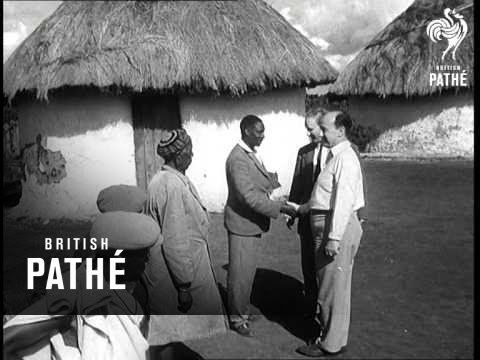
    In 1955 Adlai Stevenson, the Democrat who had lost the 1952 US presidential election to Eisenhower, toured colonial Kenya at the height of the Mau Mau Emergency. British Pathé footage shows him inspecting a fortified home-guard post, walking through a resettled Kikuyu village to meet Chief Nderu and elders, and browsing a Kikuyu market. His visit placed a leading American politician inside the machinery of the Emergency, among the guarded villages into which the Kikuyu had been concentrated.

  104. new

    Attorney-General condemns illegal detention of captives

    In November 1955 the Attorney-General found the army was holding captured Mau Mau far beyond the legal limits, one man since May 1953. He said no one would believe it operationally necessary and called it a shocking state of affairs, but the army and police took his objections lightly.

    • The Attorney-General stated: ‘No one is going to believe that this is operationally necessary or otherwise justifi- able; it is indeed a shocking state of affairs.’
      Fighting the Mau Mau- The British Army and , p. 256-259
  105. new

    Christian cleansing ceremony at Kamiti women's camp

    At Kamiti, Kenya's only all-female detention camp, confessed women were required to attend Bible study and a cleansing ceremony run by the Christian Council of Kenya. In September 1955 Archbishop Leonard Beecher led the first such ceremony, ritually absolving nearly one hundred female detainees of the Mau Mau oath.

  106. new

    Erskine denies the Mau Mau any belligerent rights

    Denying combatant status stripped captives of basic legal protections. After leaving Kenya, Erskine stated that there were no prisoners of war because Britain was not at war and did not grant the Mau Mau the rights of a belligerent.

    • After leaving Kenya in 1955, General Erskine stated: ‘there were no Prisoners of War since we were not at war and did not give the Mau Mau the rights of a belligerent’.
      Fighting the Mau Mau- The British Army and , p. 71-74
  107. new
  108. new
  109. new
  110. new

    Second surrender offer and cease-fire declared

    In January 1955 the colonial government made another attempt at negotiations, declaring a two-week cease-fire and dropping leaflets offering amnesty to Mau Mau who surrendered. Kimathi rejected the offer, deepening splits among the forest leadership.

  111. new

    The 'double amnesty' shields security forces from prosecution

    On 18 January 1955 the government announced a double amnesty: Mau Mau who surrendered would be immune from prosecution, and so would all security force members for crimes committed before the amnesty. It came as CID inquiries into Home Guard malpractice threatened morale.

    • government announced a ‘double amnesty’ whereby Mau Mau surrenderers would be immune from prosecution, as would all security force members for crimes committed before the amnesty.
      Fighting the Mau Mau- The British Army and , p. 39-42
  112. new

    Field Marshal Musa Mwariama and the Meru Fighters

    Musa Mwariama led Mau Mau fighters in the Meru forests on the eastern side of Mount Kenya and rose to the rank of field marshal within the movement. He held out in the forest for years and was among the fighters who remained active late into the Emergency. He came out of the forest around independence and was publicly received by Jomo Kenyatta in 1963. His long survival illustrates how the forest war persisted in pockets even as the wider revolt was crushed.

  113. new

    Psychological Warfare and the Surrender Appeals

    The security forces waged a psychological campaign to loosen the oath's hold on the forest fighters. Aircraft fitted with loudspeakers broadcast surrender appeals over the forest, leaflets promised safe conduct to those who gave up, and captured fighters and cleansed former members were used to persuade others to come out. The effort aimed squarely at the bond the oath had created, trying to convince fighters that the vow could be broken without ruin. It worked alongside the military sweeps to wear the movement down.

  114. new
  115. new

    Kimathi presents his defense at the Nyeri High Court

    On 23 November 1956, a month after being shot and wounded, Kimathi took the defendant's chair to give evidence. His defense rested on epilepsy and a claim of self-defense against fellow forest fighters, putting Mau Mau's internal debates on public trial.

  116. new
  117. new

    Kimathi's appeal dismissed by the East African Court of Appeal

    After Chief Justice O'Connor found Kimathi guilty and sentenced him to death, the verdict was challenged on appeal. The East African Court of Appeal summarily dismissed the challenge on 27 December 1956, after which the case went to the Privy Council.

  118. new
  119. new

    Kimathi's capture ends the military phase

    Although the Emergency ran on until 12 January 1960, the military phase effectively ended with the capture of Dedan Kimathi on 21 October 1956. British Army units were withdrawn from forest operations against the Mau Mau on 17 November 1956.

  120. new

    Special emergency assize courts try thousands of suspects

    Kimathi was tried within a fast-tracked colonial justice system. Between July 1953 and December 1956 the special emergency assize courts heard 1,211 cases in which 2,609 African suspects stood trial, convicting 1,574, all of whom received death sentences.

  121. new

    Dedan Kimathi Captured and Executed

    Dedan Kimathi was wounded and captured near the Aberdare forest in October 1956, effectively ending organized forest resistance. He was tried, convicted, and hanged at Kamiti Prison on 18 February 1957. The colonial government treated his execution as the symbolic defeat of Mau Mau, while for many Kenyans he became a lasting martyr of the freedom struggle. The location of his remains was never disclosed by the colonial authorities and has never been found.

  122. new

    Documented Abuses in the Emergency

    A body of evidence, including camp records, official inquiries, and later court testimony, documents systematic abuses under the Emergency: beatings, torture, forced labor, castration, and killings of detainees and villagers. Some officials and settlers raised alarms at the time, and a few prosecutions followed, but abuses were widely tolerated as necessary to the campaign. The scale of the mistreatment was long downplayed in official accounts and only fully surfaced in later scholarship and litigation. The British government eventually acknowledged that detainees had been tortured and abused.

  123. new
  124. new

    Britain marginalises the Geneva Conventions in the colonies

    Britain took part in the 1949 Geneva negotiations reluctantly, showing open hostility to Common Article 3, which extended protection to civilians in internal conflicts. It delayed ratification until 1957, so soldiers sent to Kenya knew almost nothing of any legal constraints.

    • The British government participated in the negoti- ations leading to the conventions with reticence, displayed open hostility towards Common Article 3 and delayed ratification until 1957.
      Fighting the Mau Mau- The British Army and , p. 79-82
  125. new

    British claim victory over Mau Mau

    Though the emergency officially lasted until 1960, the capture and execution of Kimathi in 1956 and 1957 allowed the British to claim victory over Mau Mau. It also cemented his place among the martyred leaders of a failed rebellion.

  126. new

    Dedan Kimathi executed by hanging

    With all legal appeals exhausted, Kimathi was hanged early on the morning of 18 February 1957 at Kamiti Prison in Nairobi. He was buried in an unmarked grave in the prison grounds, and his body has never been recovered.

  127. new

    Doris Lessing condemns Kimathi's execution

    Kimathi's death drew international protest. Writing in the Daily Worker, the author Doris Lessing called his execution a completely barbarous act, while the exiled South African trade unionist Solly Sachs predicted it would provoke horror across Africa and beyond.

  128. new

    Regulation 17 legalizes force against detainees

    To give Terence Gavaghan's Operation Progress legal cover, attorney general Eric Griffith-Jones drafted a distinction between lawful "compelling force" and unlawful "punitive force." Colonial Secretary Lennox-Boyd then approved Regulation 17 of the Emergency (Detained Persons) Regulations, licensing systematized violence to break remaining detainees.

    • This rhetorical hairsplitting provided some comfort to the colonial secretary, and he approved Regulation 17 of the Emergency (Detained Persons) Regulations, which gave license to all of his men on the spot to employ systematized violence in order to break down remaining detainees.
      Imperial reckoning - the untold story of Britains Gulag in
  129. new

    The dilution technique institutionalizes camp violence

    By 1957 prisons officer John Cowan had developed the "dilution technique" at the Mwea camps, which colonial officials embraced as a systematic method for breaking hard-core detainees. Small groups were isolated and overpowered with fists, clubs, and whips until they submitted and confessed their oaths.

  130. This is the named Mwea phase: Gavaghan turns dilution from a general camp method into an administered program.

    new

    Operation Progress systematizes violence at the Mwea camps

    also in Colonial concentration camps and atrocities across the empires, Paternal praise, colonial violence: Britain in Kenya, The British Empire and its dark history, The Kenya Police: from colonial force to a record of crimes, The Mau Mau oath: how a sacred rite bound a movement

    Terence Gavaghan was appointed District Officer in Charge of Rehabilitation and took control of the Mwea detention camps under Operation Progress. The program moved hard-core Mau Mau detainees through the dilution technique: small groups were isolated, stripped of old clothing, shaved, forced into prison uniform, pressed to confess the oath and beaten when they resisted. Governor Evelyn Baring and Attorney General Eric Griffith-Jones treated this violence as a necessary shock and sought legal cover for compelling force. Operation Progress matters because it shows British brutality as policy and administration, not loss of control.

  131. new

    Lokitaung prisoners' water embargo letter published

    On 8 June 1958 the Observer published a letter from the political prisoners held at Lokitaung, signed by all except Kenyatta, describing years of beatings, illness, and a deliberate cutoff of drinking water. The prisoners compared their treatment to Nazi concentration camps and appealed to world opinion.

  132. The honour matters because it shows reward, not rogue discipline: Mwea was valuable to the colonial state.

    new

    Gavaghan receives an MBE after the Mwea camp campaign

    also in Colonial concentration camps and atrocities across the empires, The British Empire and its dark history

    Terence John Frederick Gavaghan, District Officer in Charge of Rehabilitation at the Mwea Works Camps, was appointed MBE in the 1958 Birthday Honours. Later biographical accounts connect the honour and promotion to his work unblocking the detention system. The point is direct: the empire did not merely tolerate the Mwea method; it rewarded the officer associated with it.

  133. new
  134. new

    Hola Camp Massacre

    also in Colonial concentration camps and atrocities across the empires, Paternal praise, colonial violence: Britain in Kenya, The Mau Mau oath: how a sacred rite bound a movement

    Guards at the Hola detention camp beat eleven detainees to death and seriously injured dozens more after they refused forced labor, in an incident colonial officials initially tried to explain away as deaths from drinking contaminated water. A subsequent inquiry exposed the cover-up and the routine violence within the camp system, causing a political scandal in Britain. The massacre became a turning point in British public and parliamentary opinion against the emergency measures and contributed to the winding down of the detention system.

  135. new

    Hola Massacre

    also in The Kenya Police: from colonial force to a record of crimes

    Guards at Hola detention camp beat to death eleven Mau Mau detainees who refused forced labor, part of the wider colonial detention system that police screening had fed. The killings were initially covered up as deaths from contaminated water before an official inquiry exposed the beatings, provoking outrage in the British Parliament and accelerating the end of detention without trial in Kenya.

  136. new

    Lancaster House talks chart Kenyan independence

    In January 1960 the first constitutional conference at Lancaster House set Kenya on the path to majority rule, with Colonial Secretary Iain Macleod announcing a parliamentary democracy based on universal franchise. Settlers were stunned, but the aftermath of Hola had made continued British rule untenable.

  137. new

    End of the Mau Mau Emergency

    also in The Kenya Police: from colonial force to a record of crimes

    The colonial government formally lifted the State of Emergency after nearly eight years, during which police, Special Branch, the GSU's colonial-era precursor units, and military forces killed an estimated 11,000 or more Mau Mau fighters and detained roughly 150,000 to 320,000 Kenyans, figures drawn from British colonial records and later historical research. The Emergency left the Kenya Police with an institutional legacy of counter-insurgency and mass detention.

  138. new

    The State of Emergency Ends

    The government lifted the State of Emergency after more than seven years, with the forest revolt long since crushed and most detainees released or dead. In the same period the first Lancaster House conference in London opened the path toward African majority rule. The end of the Emergency shifted the struggle from the forests to constitutional negotiation. Many former fighters and detainees emerged to find their land gone and loyalists in control.

  139. new

    The Disputed Death Toll

    The human cost of the Emergency is sharply contested. Official colonial figures recorded about 11,000 to 12,000 Mau Mau and suspects killed, along with roughly 1,800 African civilians and 32 European settlers killed by Mau Mau. Historian Caroline Elkins later argued from census analysis that the true toll of deaths in the camps and villages ran into the tens of thousands and possibly far higher, while demographer John Blacker estimated around 50,000 excess deaths and historian David Anderson put combat deaths near 20,000. These estimates remain disputed, and the higher figures are attributed to their authors rather than settled fact.

  140. new

    The Release of Jomo Kenyatta

    After nearly nine years in detention, Jomo Kenyatta returned home to Gatundu in Kiambu on 14 August 1961, healthy and dignified despite Governor Renison having branded him 'the leader to darkness and death.' He soon took the leadership of KANU and moved toward power as Kenya's independence approached.

  141. new

    Demographic estimate of Kikuyu deaths

    Elkins challenges the official figure of about eleven thousand Mau Mau killed. Comparing the 1948 and 1962 censuses and adjusting Kikuyu growth against neighboring peoples, she finds that between 130,000 and 300,000 Kikuyu are unaccounted for, pointing to a far larger death toll from the camps and villages.

  142. new

    KANU's Election Victory and Kenyatta's Rise to Power

    The Kenya African National Union, led by Kenyatta, won a runaway victory in the 1963 national elections and swept him into power as Kenya's first president, fulfilling the British aim of handing over to conservative allies. Kenya achieved full independence on 12 December 1963, and Kenyatta urged Kenyans to forget Mau Mau.

  143. new

    Kenyan Independence

    also in The British Empire

    Kenya gained independence under Jomo Kenyatta after years of settler resistance and the Mau Mau war. Its freedom marked the near end of British East Africa.

  144. new

    Operation Legacy and the Destruction of Records

    As independence approached, British officials systematically destroyed or removed colonial records that might embarrass the government or implicate officials in abuses, a practice later known as Operation Legacy. Sensitive files on the Emergency were burned, dumped at sea, or shipped secretly back to Britain rather than handed to the new Kenyan government. The removals hid the documentary record of detention and abuse for decades. The existence of this purge was only officially confirmed much later.

  145. Rosberg and Nottingham attacked the colonial myth: Mau Mau was political nationalism, not madness.

    new

    The Myth of Mau Mau reframes the uprising as nationalism

    also in The Mau Mau oath: how a sacred rite bound a movement

    Carl G. Rosberg Jr. and John Nottingham published The Myth of "Mau Mau": Nationalism in Kenya, a major early challenge to the colonial line that Mau Mau was irrational savagery. The book treated the uprising as a nationalist and political movement rooted in land, state violence and colonial rule. Nottingham mattered because he had been inside the colonial administration and later helped carry evidence of abuses into public view.

  146. new
  147. new

    Mandela invokes Kimathi on his first visit to Kenya

    On his first visit to Kenya in July 1990, Nelson Mandela invoked Kimathi in a speech at Kasarani Stadium, saying the image of fighters like Kimathi had sustained him through 27 years of imprisonment. He lamented the absence of a proper burial site for Kimathi.

  148. new

    How Central Was Oathing? The Historians' Debate contested

    Historians disagree over how far the oath explains Mau Mau. The colonial state saw it as the master key, a single sinister ritual that created and controlled the movement, and much writing followed that lead. Later scholars such as John Lonsdale read oathing instead as one expression of a wider Kikuyu argument over land, wealth, and civic virtue, and they stress that the rites varied by place and were never centrally scripted. On this view the oath mattered as a means of commitment, not as the movement's cause. The debate turns on scarce and contested evidence, much of it filtered through hostile records.

  149. The evidence reached television before the migrated archives became public. That matters for the compensation story.

    new

    Kenya: White Terror brings the camp evidence to television

    also in Colonial concentration camps and atrocities across the empires, Operation Legacy: the empire burned its records

    BBC Two's Correspondent film Kenya: White Terror broadcast survivor testimony and documentary evidence on British torture, rape, murder and forced confession during the Mau Mau Emergency. The film included Terence Gavaghan, by then an elderly former colonial officer, and focused attention on secret memos showing official approval for violence in the camps. Its scheduling was itself contentious inside the BBC because the film exposed British atrocities around Remembrance Sunday. The broadcast helped push the camp story from archive and survivor memory into public reckoning.

  150. new

    Kibaki lifts the colonial ban on Mau Mau

    also in Mwai Kibaki: economist, opposition bridge, and Kenya's post-Moi presidency

    President Mwai Kibaki lifted the colonial ban on Mau Mau as an organization in 2003, shortly after his National Rainbow Coalition took power. The move triggered renewed demands for veterans' recognition and for the rewriting of Kenya's liberation history.

  151. new

    Mau Mau in Kenyan Memory

    The ban on Mau Mau, kept in force since the colonial period, was lifted by the Kibaki government in 2003, allowing the movement to be openly commemorated. A statue of Dedan Kimathi was unveiled in central Nairobi in 2007, marking his shift from outlawed rebel to national hero. Yet the movement's memory stays contested, dividing those who see it as the engine of independence from those who recall its violence against fellow Africans, and from loyalist families who kept the land and power. Debate over who won and who was rewarded continues in Kenyan public life.

  152. new

    Chuka massacre file sealed until 2038

    The file on the Chuka massacre contains eleven pages the government retained until 2038. When Lord Steel asked about them in the House of Lords in 2006, the government said they held statements by three Kenyan women raped by African soldiers.

  153. new

    Mau Mau lawsuit exposes the hidden Hanslope archive

    In 2009 a group of Kenyans alleging mistreatment began legal proceedings against the Foreign and Commonwealth Office. Two years later this led to the discovery of a hidden colonial archive at Hanslope Park, holding records from 37 colonial territories in some 8,800 files.

    • In 2009 a group of Kenyans who alleged mistreatment at British hands during the Emergency began legal proceedings against the Foreign and Commonwealth Office. Two years later this led to the discovery of a hidden colonial archive at Hanslope Park, home to Her Majesty’s Government Communications Centre.
      Fighting the Mau Mau- The British Army and , p. 14-16
  154. Nottingham is important because he was inside the colonial service, then helped the survivors against Britain.

    new

    John Nottingham supports Mau Mau veterans' compensation case

    also in Colonial concentration camps and atrocities across the empires, Operation Legacy: the empire burned its records, The British Empire and its dark history

    As Mau Mau veterans pushed a compensation case against Britain, John Cato Nottingham, a former colonial district officer who had broken with the administration over abuses, publicly supported the claimants. He became a rare white Kenyan witness against the colonial system he had served. His role ties the camp evidence to the later legal reckoning and to the people who preserved the story before the archives were opened.

  155. new

    The Hidden Migrated Archive Revealed

    During the Mau Mau veterans' lawsuit, the British government admitted it held a secret archive of colonial-era files at Hanslope Park that it had long denied existed. The migrated archive contained thousands of files removed from Kenya and other colonies at independence, including records of the Emergency. Historians who examined the papers found documentation of detention conditions, interrogation methods, and official knowledge of abuse. The disclosure confirmed both the scale of the abuses and the deliberate concealment of the record.

  156. new

    The Mau Mau Veterans' Case Against Britain

    Elderly Kenyan claimants, among them Ndiku Mutua, Wambugu wa Nyingi, Paulo Nzili, and Jane Muthoni Mara, sued the British government over torture and abuse suffered in the detention camps. In 2011 and 2012 the High Court rejected London's arguments that too much time had passed and that liability had transferred to independent Kenya, allowing the case to proceed. The rulings opened British courts to claims arising from colonial conduct. The newly revealed Hanslope files strengthened the claimants' evidence.

  157. new

    Britain agrees to compensate Mau Mau veterans

    Following a reparations case brought in London's High Court, in 2013 the British government announced a negotiated settlement, paying 21.5 million dollars in compensation to 5,200 Mau Mau veterans for abuses suffered during the colonial counterinsurgency.

  158. new

    The 2013 Settlement and British Regret

    The British government agreed to pay around 19.9 million pounds to more than 5,000 elderly Kenyans who had suffered abuse during the Emergency. Foreign Secretary William Hague told Parliament that Britain sincerely regretted the torture and mistreatment and that it should not have happened, though the settlement carried no formal admission of legal liability. The government also funded a Mau Mau memorial in Nairobi. It was a rare acknowledgment of colonial abuse, while its limits and the exclusion of later claimants remained contested.

Further reading

Change log

1 change

  1. Linked to "Ecology and environment" as part of in this story